
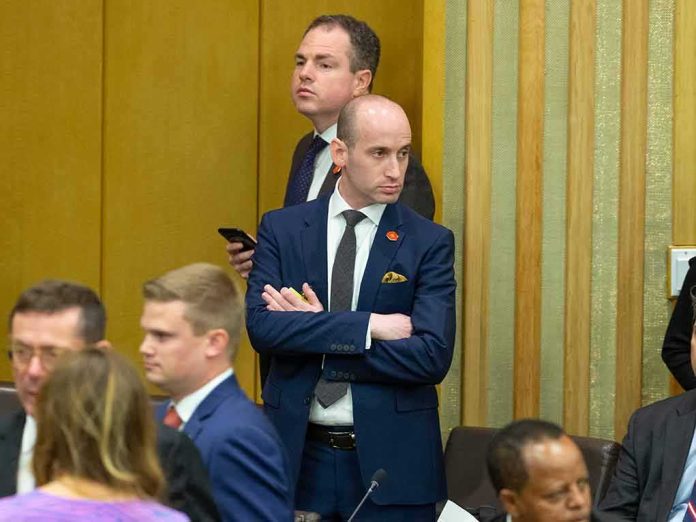
West Wing leadership changes are rarely about one person; they reset how power moves through the building. Stephen Miller’s elevation to White House chief of staff, and Deputy Chief of Staff Richard Walters’s exit that followed, is a textbook example—clear on the facts, unsurprising in the pattern, and consequential for how the administration will run its day-to-day.
At a Glance
- President Trump named Stephen Miller the 33rd White House chief of staff, effective November 9, 2026, succeeding Susie Wiles.
- Trump publicly framed Miller as a long‑time, trusted adviser and set the transition’s timing in his own statement.
- Deputy Chief of Staff Richard Walters offered his resignation as Miller took the helm; the parties involved described the departure as amicable.
- Turnover around a chief‑of‑staff change is common; modern chiefs average roughly two years in the role, and reorganization often prompts deputies to exit.
What Happened: A Clear Line of Succession and a Prompt Deputy Departure
The White House announced President Trump’s selection of Stephen Miller as the 33rd White House chief of staff, with the transition date specified and the succession from Susie Wiles stated plainly. The appointment notice did more than check procedural boxes; it cemented Miller’s formal authority after years as a senior adviser, aligning title and influence. Trump’s public framing matched the document: Miller is a long‑serving confidant, now tasked with commanding the West Wing’s calendar, paper flow, and personnel alignment. Together, the official release and the president’s message render the core facts uncontested—who, what, and when are not in dispute.
In the immediate slipstream of that elevation, Deputy Chief of Staff Richard Walters resigned. Reporting indicates he offered his resignation and that the separation was amicable, a characterization reinforced by Miller’s own statement praising Walters’s contributions and noting he would continue to assist from outside government. The sequencing is familiar to anyone who has watched West Wing management cycles: a new chief arrives; deputies and allied staff reassess their roles; exits cluster in the opening moves of the reorganization.
How a Chief of Staff Rewires the West Wing
The White House chief of staff is the president’s principal internal manager, responsible for organizing decision processes, adjudicating access, and translating broad directives into executable tasks. The job is operationally punishing—triaging crises, keeping policy tracks synchronized across agencies, and protecting the president’s finite time. Since the role hardened under the modern presidency, turnover has been brisk: by one authoritative review, 26 individuals have served since 1969, with an average tenure of about two years, a rate that reflects the intense stresses and the political rhythms that drive retooling. A new chief typically revises reporting lines, reshapes the senior staff’s mandate, and installs trusted operators in key choke points—scheduling, policy councils, legislative affairs—moves that often prompt deputy-level departures whether or not friction is visible to the outside world.
In that light, Walters’s resignation reads as part of the standard administrative choreography. The practical effects are immediate even if the politics draw headlines later: briefing protocols change, the memos that reach the Resolute Desk look different, and issues the chief prioritizes accelerate through the system. When the incoming chief has long been a principal in the administration’s agenda—as Miller has been on immigration, rulemaking posture, and communications strategy—the organizational refresh tends to be both swift and substantive.
Stephen Miller’s Path to the Center Seat
Miller’s formal promotion codifies a reality that has defined multiple phases of the Trump years: he has been central to the administration’s ideological throughline and to the mechanics of policy execution. The appointment release leans into that continuity, describing him as present “since the very beginning” and crediting him with driving signature priorities the White House claims as achievements. The release functions not only as a personnel notice but also as a statement of management intent—continuity of agenda paired with tightened control in the chief’s office.
In practical terms, a Miller-led West Wing means a more vertically integrated operation: fewer ad hoc process lanes, clearer lines of authority between the chief’s office and policy councils, and a premium on speed to implementation. Chiefs imprint style as well as structure. Some emphasize interagency consensus-building; others put a thumb on the scale for presidential priorities even at the cost of internal friction. Miller’s reputation suggests the latter—an assertive gatekeeper model in which alignment with the president’s program is the sorting mechanism for time, attention, and staff energy.
The Walters Exit: What We Know and How to Interpret It
On the facts, the record is straightforward. Walters served as deputy chief of staff, offered his resignation as Miller assumed the top job, and received public commendation on the way out. Accounts from those in position to know call the departure amicable, and there is no contrary on‑record evidence. This is the base case in a chief‑of‑staff changeover: deputies evaluate their future operating latitude under the new structure, and some choose to leave as roles compress or portfolios shift. The lack of dramatic ornament does not make the move trivial; it reflects the ordinary but consequential elasticity of senior staffing around a powerful node.
A single, brief caveat belongs here because it is intrinsic to West Wing staffing: public statements rarely detail private deliberations about role scope or future assignments. That does not shake the basic account; it simply reminds us that the visible record captures outcomes and official characterizations, not every negotiation along the way. The prudent reading remains the simple one—the deputy exited in the immediate reorganization window and did so with the administration’s public thanks.
Why This Matters for Governance
Chiefs of staff determine tempo. With Miller installed, expect tighter prioritization around the president’s core agenda, more aggressive use of executive branch levers, and a staff model organized for rapid decision cycles. That has downstream implications for Congress, agencies, and litigation strategy. On the Hill, a disciplined chief can narrow the docket to a handful of negotiables while hardening positions elsewhere. In the agencies, an activist chief’s office tends to centralize review, accelerating aligned initiatives and stalling those that do not ladder to presidential objectives. In court-facing work, process discipline—records, rationales, and interagency sign‑offs—often decides whether ambitious policies survive scrutiny; chiefs who master this craft can materially change outcomes.
Turnover in Context: Normal, but Not Neutral
Senior staff churn is not a crisis signal by itself; it is the normal respiration of a presidency. The modern record shows how routine this is, particularly at inflection points such as a new chief’s arrival. What differs across administrations is what turnover accomplishes—consolidation, course correction, or renewed focus. When a president installs a chief synonymous with the administration’s ideological spine, departures that follow generally indicate consolidation rather than reconciliation. That is the operative read here: a reset meant to align personnel, process, and policy around the president’s priorities, with Walters’s exit one of the first visible markers.
Sources:
themirror.com, axios.com, brookings.edu