
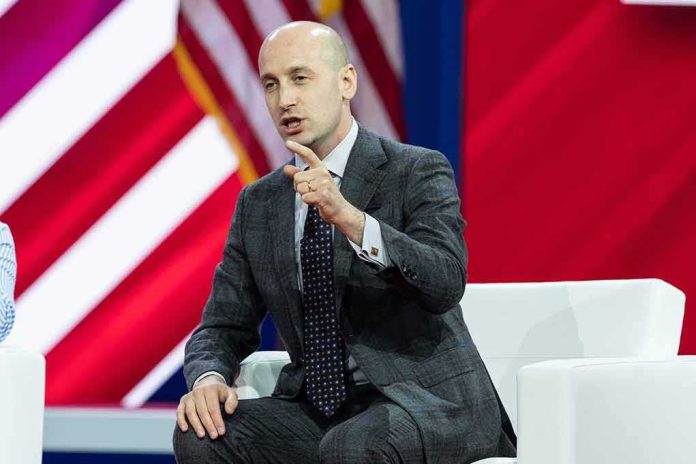
Personnel choices at the top of the White House are never just about résumés; they are declarations of governing intent. President Trump’s elevation of Stephen Miller to White House chief of staff — announced with unusual clarity about timing and succession — signals a consolidation of influence around a long-serving confidant whose portfolio has consistently fused policy hard lines with operational discipline.
At a Glance
- President Trump appointed Stephen Miller as the 33rd White House chief of staff, succeeding Susie Wiles, with the change scheduled to take effect the first business day after the announcement.
- The White House framed Miller as a trusted senior adviser central to priorities like border security and crime policy, reflecting continuity with Trump’s core agenda.
- Multiple outlets independently corroborated the leadership change and effective date, and Miller publicly accepted the role.
- The timing — immediately after Republican midterm losses — places the move in a familiar pattern of post-election restructuring.
What Happened: A Clear, Direct Succession
The White House announced Stephen Miller as the 33rd chief of staff, explicitly naming Susie Wiles as his predecessor and setting an effective date at the start of the following week. The statement presented a straightforward personnel action: Miller, then serving as deputy chief of staff, would assume the top West Wing management role and Wiles would move to the political operation. Major outlets including NPR, Reuters, NBC affiliates, and The Hill reported the same contours — Wiles out, Miller in, effective Monday — citing the president’s announcement and on-record reactions from Miller himself. The through-line across those reports is consistent: a planned, immediate handoff in the most powerful unelected role in the executive branch.
White House language around the appointment emphasized proximity and tenure — Miller has been at Trump’s side “since the very beginning” — and cast him as an operational driver behind priorities on immigration enforcement, crime, and fraud. The title shift therefore looks less like a break with the president’s governing approach and more like a formal elevation of a figure already central to strategy and execution. The official release also praised Wiles’s service and outlined her next assignment, smoothing the continuity message even as it underscored the urgency of the changeover.
How This Role Works — And Why This Choice Matters
The White House chief of staff is the president’s integrator: gatekeeper, traffic cop, and enforcer. The job concentrates four levers. First, information flow — deciding what reaches the Resolute Desk and in what sequence. Second, personnel — hiring and discipline across the Executive Office of the President and, by extension, influence over agency appointments. Third, policy process — choreographing interagency coordination so decisions become executable directives. Fourth, time — the president’s most constrained resource. A chief of staff aligned with the president’s instincts can collapse decision cycles and harden priorities; a misaligned one becomes a friction point the system routes around. Miller’s elevation means the integrator function now sits with one of Trump’s closest ideological and tactical allies.
Titles aside, effectiveness in this role turns on trust with the president and command of process. Miller has both in the frame laid out by the White House and the corroborating coverage. He arrives not as a neutral chief administrative officer but as a principal with standing in the policy debates that have defined the administration — especially immigration and border enforcement — and with the president’s public confidence. For a West Wing that prizes directness and speed, that combination typically yields tighter message discipline and more assertive follow-through with agencies.
The Immediate Context: Post-Election Resets Are a Presidential Tradition
The timing invites a political reading: the shift followed midterm elections in which Republicans lost control of both chambers of Congress. Administrations often recalibrate after defeats — sometimes to course-correct, sometimes to double down. In Trump’s case, rapid senior-staff reorganizations have been part of the governing repertoire before; his first term cycled through four chiefs of staff. Reporting around this transition consistently situates Miller’s appointment within that familiar pattern: a prompt, top-tier staffing change in the wake of electoral setbacks, intended to reassert control over legislative strategy and executive action.
Susie Wiles’s tenure nonetheless set a contrast. Described as Trump’s longest-serving chief of staff, she arrived as a political operator and leaves credited with professionalizing aspects of West Wing process. Moving her to the political operation keeps her inside the tent — an arrangement that, in functional terms, could sharpen the delineation between governing execution (Miller) and political infrastructure (Wiles and allies) as the administration manages a divided government.
Stephen Miller’s Portfolio Becomes an Operating System
What changes when a policy architect becomes chief of staff? First, prioritization. Expect White House calendars, principals’ meetings, and interagency tasking to concentrate on issues Miller has historically driven — border enforcement, asylum process tightening, and crime initiatives — with faster internal clearance for associated actions. Second, coordination style. Chiefs drawn from policy combat often favor smaller, loyalist decision cells and tighter message lanes, trading some deliberation breadth for speed. Third, enforcement. Agencies get fewer mixed signals when the chief of staff is also the policy’s champion; compliance with White House directives tends to rise when follow-through is personal. The president’s framing of Miller as a “driving force” suggests precisely that operating model.
There are limits. The chief of staff cannot conjure statutory authority that does not exist, and a Congress controlled by the opposition can slow or block legislative ambitions. But the office can saturate the administrative state with guidance, direct rulemaking priorities, and sharpen litigation posture — tools this White House has used before. In practical terms, the Miller appointment is best understood as an accelerant on the administration’s existing agenda rather than a pivot to something new.
Should have known Stephen Miller would appoint himself Chief of Staff. Wonder if he'll announce he's also Commander in Chief or just continue to keep that secret.
— VanceInLA (@vanceinla) November 7, 2026
Why Now, and What to Watch Next
Presidents use personnel to solve the problems immediately in front of them. After a midterm loss, two problems dominate: regaining narrative control and hardening execution under divided government. Installing a trusted deputy with intimate knowledge of the president’s preferences addresses both. It shortens the distance between decision and action and concentrates accountability in someone the president will back publicly. The White House’s emphasis on Miller’s long service and centrality to signature initiatives aligns with that logic.
Three early indicators will show how consequential this shift becomes. First, process discipline: watch for fewer ad hoc workarounds and more formal taskings to agencies, a hallmark of an empowered chief of staff. Second, agenda density: a tighter cluster of immigration, crime, and antifraud actions moving in parallel would reflect Miller’s imprint. Third, Hill strategy: with Democrats holding both chambers, the chief of staff’s ability to sequence must-pass legislation, nominations, and oversight response will define the administration’s legislative floor. Coverage across mainstream outlets converges on the same core fact pattern — Miller in, Wiles out, effective immediately after the announcement — which frames those metrics as the right scorecard for evaluating the move.
Sources:
redstate.com, whitehouse.gov, npr.org, nbcwashington.com, nytimes.com, abc7.com, cleveland.com, en.yna.co.kr