When a sitting Supreme Court justice warns that the United States is in a “rough patch” for the rule of law, the point is not apocalypse; it is stewardship — a reminder that constitutional culture erodes from habits long before it collapses from headlines.
The Short Version
- Justice Sonia Sotomayor publicly described the country as in a “rough patch” for the rule of law, stressing strain rather than collapse.
- Her diagnosis centered on frayed civic discourse and declining civility, which she linked to weaker civic engagement.
- She framed the remedy as long-term work: recommitment to civility, equality, and robust civics education for the next generation.
- The remarks align with broader evidence of falling public confidence in legal institutions, especially the Supreme Court, though “rule of law” remains broader than approval ratings.
What Sotomayor said — and why it matters
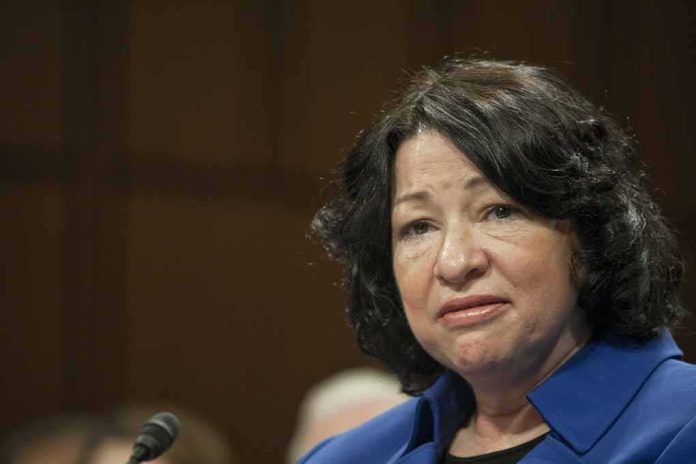
At a public conversation on civics education at George Washington’s Mount Vernon estate, Justice Sonia Sotomayor said the United States is in a “rough patch” for the rule of law, with challenges “on so many different levels.” She emphasized that the problem is serious but not terminal — it will not “end tomorrow,” and returning the system “to an even keel” will take sustained effort. Her framing was characteristically institutional: the rule of law depends not just on statutes and courts, but on civic norms — especially the willingness to treat disagreement without moral exile. “That someone disagrees with you doesn’t make them a bad person,” she said, arguing that we have forgotten this baseline of democratic life.
The comments carry weight because they come from the bench, not the bleachers. A justice lives with the daily mechanics of lawful government: due process, reason-giving, the binding force of precedent and judgment. When such an insider says the system is strained, the audience should hear a maintenance alert, not a partisan blast horn. News coverage linked her remarks to disagreements over recent Supreme Court decisions, including presidential immunity, but her core point was steadier and more civic than doctrinal: institutions cannot outpace the culture that sustains them.
The difference between confidence and the rule of law
Two realities are easy to conflate and important to separate. First, public confidence in major institutions — courts among them — has measurably weakened in recent years. Multiple survey programs document large, recent drops in trust and growing partisan divergence in views of the Supreme Court, a change from its historically cross-partisan reservoir of legitimacy. Second, the “rule of law” is broader than trust metrics. It encompasses core conditions: that law binds rulers and ruled alike; that rights are protected and remedies exist; that elections are regular and respected; that opposition is legitimate. Low approval can coexist with lawful function; high approval can mask creeping abuses. Sotomayor’s warning sits at this intersection: trust is a leading indicator, but not the whole diagnostic panel.
Outside the United States, comparative assessments sharpen the lens. The World Justice Project’s Rule of Law Index has described a “rule of law recession” globally, driven by shrinking civic space and weakened checks and balances. While international aggregates cannot adjudicate any single country’s internal disputes, they help contextualize concerns about norms that anchor lawful government: transparency, constraint, accountability, and civil liberties.
Mechanisms of strain: discourse, norms, and compliance
Why focus on civility? Because the rule of law is ultimately a compliance culture. Courts issue reasons and remedies; executives and citizens choose whether to accept, contest within lawful channels, or defy. A thick culture of “loser’s consent” — the willingness to abide adverse outcomes pending appeal or election — is sustained by everyday habits: granting good faith to opponents, distinguishing error from evil, and resisting maximalist rhetoric that treats legal disagreement as illegitimacy. When these habits fray, three predictable mechanisms appear: selective acceptance of outcomes, increased harassment and delegitimization of legal actors, and strategic forum-shopping for partisan validation. Each is corrosive; together they normalize the idea that law is merely politics by other means.
Sotomayor’s civics-forward remedy matches the mechanism. Civic education that teaches both constitutional structure and the ethics of disagreement is not nostalgic; it is infrastructural. Evidence from public-opinion research suggests that civics knowledge correlates with higher trust in courts, even amid polarization. Knowledge alone does not reverse sorting by partisanship, but it can blunt fatalism — the belief that institutions are nothing but teams — and increase tolerance for adverse rulings as part of a legitimate process.
How we got here: a brief trajectory
Institutional trust tends to be cyclical, but the last half-decade stands out. Surveys chart a pronounced decline in confidence in the Supreme Court after 2019, alongside widening partisan gaps in perceived legitimacy and support for structural reforms. Researchers who tracked multiple national surveys and panel data over a 20-year span conclude that a historically cross-partisan institution has been pulled into the broader gravitational field of polarization.
This is not the first American season to test the constitutional order. Comparing across episodes — the Civil War and Reconstruction, the 1890s, the 1930s, the civil-rights era, and Watergate — scholars often evaluate the same four pillars: free and fair elections, the rule of law, legitimate opposition, and rights protection. The point of such comparison is discipline: to avoid both complacency and melodrama. Institutions have weathered serious storms; they do not heal by accident. They recover because leaders and citizens recommit to norms that let law work: accepting lawful outcomes, protecting dissent, and reserving extraordinary measures for extraordinary threats.
Where the disagreement actually lives
Reasonable people will disagree about the doctrinal correctness of recent Supreme Court rulings, including on presidential immunity. That is normal in a constitutional system that entrusts final legal meaning to a multimember court by design. Sotomayor’s “rough patch” language does not depend on winning those specific doctrinal fights. It rests on something prior: whether our political community treats law as binding even when it bites, and whether we teach the next generation to distinguish adversaries from enemies. On that prior question, one can acknowledge plural legal views while agreeing that civility and civic competence are not luxuries; they are operating conditions for a lawful republic.
One clarifying test separates policy disappointment from rule-of-law danger: do actors comply with adverse judgments, pursue change through lawful means, and respect the legitimacy of opposition to govern later? If yes, the system is bruised but operating. If no — if noncompliance, intimidation, and permanent delegitimization dominate — the system is in true peril. Sotomayor’s emphasis on discourse and education points to this compliance hinge.
Justice Sotomayor said that the U.S. is experiencing a “rough patch” for rule of law and civic discourse, but one that can be overcome through a greater commitment to civility, equality and educating young people about America’s enduring values.https://t.co/BZM08P9oUk @politico
— BriteHeart (@BriteHeartNow) November 8, 2026
What it means going forward
Take the justice’s warning as a work order. The immediate task is not invention but reinforcement: teach constitutional structure and the ethics of disagreement early and often; defend the mundane but essential rituals that embody equal justice, from reasoned opinions to peaceful acceptance; and resist the short-term incentives that treat legal loss as proof of illegitimacy. Reform debates will continue — about Court ethics, docket management, or structural change — but none will matter if the civic substrate keeps thinning. Culture is the load-bearing wall.
Sources:
politico.com, quorumreport.com, rmb.reuters.com, ncbi.nlm.nih.gov, annenbergpublicpolicycenter.org, onlinelibrary.wiley.com, judicature.duke.edu, pmc.ncbi.nlm.nih.gov, cambridge.org, americanbar.org, journals.sagepub.com