When a workplace turns into a shooting scene, seconds decide outcomes; at Citibank’s Tampa-area campus, a four-minute interval between the first 911 calls and an armed security guard’s engagement with the gunman defined the day’s toll and almost certainly limited it.
At a Glance
- An armed Citibank security guard confronted and fatally shot the gunman within minutes, ending the attack while thousands were on campus.
- Roughly 3,200 employees were present; one woman was killed, four others sustained non-life-threatening injuries, and the suspect later died at the hospital.
- Hillsborough County Sheriff’s Office deployed 367 deputies and completed a building-wide clearance in about two and a half hours.
- The sheriff’s office described the event as an active threat; early reporting also referenced a targeted motive, later tied to a $2,500 debt dispute in subsequent coverage.
What Happened: A Rapid Attack, A Faster Intercept
The sequence was stark and compressed. Shortly after noon, the gunman drove onto the Citibank campus near Tampa, breaching exterior barriers into a courtyard and approaching an outdoor seating area with a rifle. He fatally shot a female employee; moments later, he advanced toward or into the cafeteria. Multiple 911 calls hit the Hillsborough County Sheriff’s Office at 12:11 p.m. By approximately 12:15 p.m., an armed Citibank security guard engaged the suspect in a gunfight that ended the active threat. The wounded suspect was transported to Tampa General Hospital and later died. In addition to the woman who was killed, four people suffered non-life-threatening injuries during the incident and evacuation.
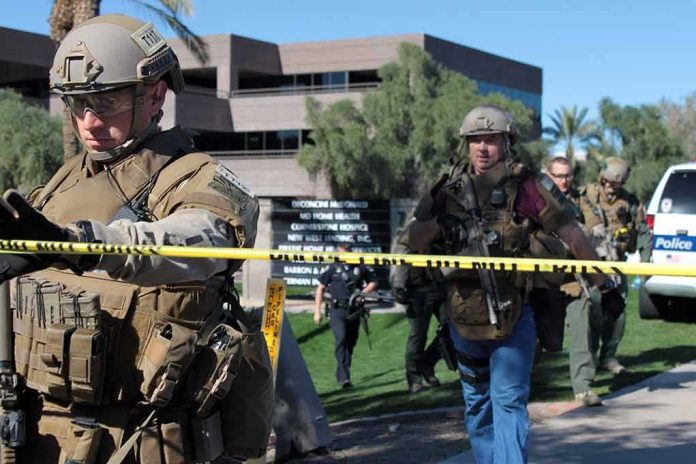
The broader response was sizable and systematic. According to local reporting on the sheriff’s briefing, 367 deputies surged to the multi-building campus, integrating patrol, tactical, and investigative teams. Clearing operations spanned inside and outside the cafeteria and concluded after roughly two and a half hours. The law enforcement command established a reunification site while interviewing employees and preserving extensive physical and video evidence.
Active Threat Mechanics: Why Minutes Matter
“Active shooter” is an operational category, not a body count; the FBI defines it as an individual actively engaged in killing or attempting to kill in a populated area. The definition is intentionally broad to drive immediate, threat-centered decisions by security and police rather than hinging on casualty thresholds or confirmed motive. From that lens, the Citibank episode was an active threat: a gunman with a rifle, movement toward a cafeteria, a live exchange with an armed defender, and an immediate risk to a campus of thousands.
Resolution paths vary. Across years of FBI-designated incidents, outcomes include suspect suicides, law-enforcement apprehensions, and, in a meaningful minority, fatal stops by law enforcement or security personnel. Recent FBI reporting places law enforcement or security killings of shooters at roughly one-fifth of outcomes in some periods. These are not the most common endings, but when they occur quickly, they often correlate with lower casualty counts because the attacker’s decision loop is interrupted by lethal resistance and coordinated containment.
The Security Intervention: Role, Timing, and Environment
The fulcrum of this case is the armed security guard’s intervention within minutes—measured against the scale of potential exposure. With approximately 3,200 employees on campus and a cafeteria in use, the guard’s movement to contact in roughly four minutes after the first emergency calls is the kind of interval active-threat doctrine is built to compress. A short engagement window shrinks the attacker’s mobility, forces him to seek cover rather than victims, and hands initiative to responders converging from multiple directions. The casualty pattern here—one killed, four injured, suspect neutralized—tracks with that timing.
Facility geography matters. Cafeterias and courtyards are high-density, predictable gathering points with lines of sight that can advantage an attacker—unless an armed defender has preplanned fields of fire and access routes. Reports indicate the guard confronted the suspect in or near the cafeteria, which suggests the defender had both rapid awareness and a workable angle to engage without compounding risk to fleeing employees. In workplace security programs that authorize armed protection, those two elements—fast recognition and tactically viable positioning—are the difference between a footnote and a mass casualty event.
Law-Enforcement Surge and Scene Stabilization
The deployment of 367 deputies to a multi-structure corporate campus reflects the other half of modern active-threat doctrine: containment, clearance, and care. The job after the trigger stops is to be sure there is no second shooter, no overlooked victim, and no booby-trapped space that could harm evacuees or responders. A two-and-a-half-hour full clearance for a campus of this size is within professional expectations, particularly with exterior and interior scenes, evacuation corridors, and a parallel medical triage and witness interview process underway.
Even when a security professional ends the shooting, the operational burden remains large: zones must be methodically searched; ballistic evidence must be mapped; and thousands of employees—stressed, scattered, and often separated from phones and cars—must be accounted for and reunited. Those tasks are not ancillary; they are the structure that prevents secondary harms and preserves a prosecutable, auditable record.
Motive, Targeting, and the Debt Dispute Reporting
Initial official language alternated between “active threat” and indications of a targeted act, a common pattern while detectives sort relationship evidence and forensics. As coverage expanded, subsequent reporting identified the suspect as driving from Orlando and allegedly motivated by a $2,500 debt dispute with the company; this same reporting tied the slain employee to Citibank and detailed the suspect’s armament and path through the campus. Authorities credited the on-site security guard with stopping the gunman and preventing further loss as employees fled and barricaded.
The distinction between targeted attack and indiscriminate rampage matters to prevention strategies—protective intelligence, threat assessment, and civil process management look different when a grievance is tightly focused. But during the minutes that matter in an unfolding assault, that nuance does not change the tactical prescription: move to the gunfire, stop the shooter, and transition immediately to casualty care and campus-wide control.
A timeline from the Hillsborough County Sheriff's Office on the Citibank Campus shooting on Wednesday, Nov. 4, near Tampa, Florida. https://t.co/PtIYXxoxGU pic.twitter.com/CCsBHsvIwV
— FOX 13 Tampa Bay (@FOX13News) November 6, 2026
Why This Case Will Be Studied
For corporate security leaders, this incident checks critical boxes: an early warning channel (external threat communications and 911), on-site armed capacity able to engage within minutes, and an integrated law-enforcement play that surged resources, locked down the perimeter, and executed a full clearance. The numbers underscore the stakes. Thousands present. One confirmed fatality, four additional injuries, and the suspect neutralized within minutes. In the universe of active threats, those are markers of a defense that worked under pressure—helped by training, posture, and campus design that allowed a defender to reach the fight fast.
For public agencies, it is a reminder that even when private security ends the shooting, the governmental load is heavy and the public narrative fragile. Precision in timelines, clear articulation of roles, and careful handling of victim identities and motive details sustain public confidence and create learning value for the next response. For employers, it argues for layered measures: credible threat reporting pathways, physical controls that slow vehicles without trapping evacuees, rehearsed internal alerts, and a security function empowered—and trained—to act decisively.
Sources:
youtube.com, apnews.com, tampabay28.com, wtsp.com, fox13seattle.com, fox35orlando.com, fbi.gov