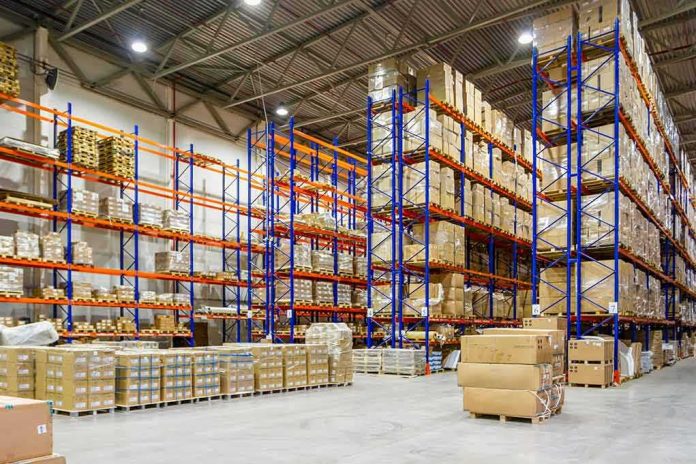
The real story behind the warehouse-to-detention push is not concrete and razor wire, but what it reveals about federal power, local pushback, and who actually controls the immigration chessboard.
Story Snapshot
- The Department of Homeland Security has quietly bought and scoped out warehouses nationwide for possible Immigration and Customs Enforcement detention use, backed by billions in funding.[1][3][5]
- Specific deals in places like San Antonio, Berks County, and other locations show this is more than a theoretical plan.[1][3][4][5]
- Local officials and residents are objecting on safety, transparency, and cost grounds, setting up a federal–local showdown.[1][2][3][4]
- Lawmakers are already trying to outlaw warehouse detention entirely, framing it as “mega-prisons” for migrants.[5]
What Washington Wants: Scale, Speed, And Anonymity
Federal planners see warehouses, not as dusty boxes along the interstate, but as the shortcut to a vast detention grid. Reporting based on internal discussions says the Department of Homeland Security is “pressing ahead” with a plan to transform industrial warehouses into large Immigration and Customs Enforcement detention and processing hubs, with contracts for retrofitting and operations already in the works.[1][2] The pitch is simple: the shells exist, the roofs are up, and outfitting is faster than building from scratch.[3][4]
Budget numbers tell the rest of the story. One report describes a $38.3 billion Department of Homeland Security budget line aimed at increasing detention capacity to roughly ninety‑two thousand beds through a combination of large detention centers and regional processing facilities.[2] Separate watchdog analysis says Immigration and Customs Enforcement is actively purchasing and converting commercial warehouses into a national network of detention sites, not one‑off experiments.[3] When Washington dedicates that kind of cash, it rarely plans for a short-lived pilot.
The Concrete Deals: From San Antonio To Berks County
San Antonio offers one of the clearest windows into how this looks on the ground. A local county commissioner publicly stated that the federal government paid more than sixty‑six million dollars for a warehouse on the city’s East Side, acquired for migrant housing purposes.[1] Local reporting says the building’s appraised value was closer to thirty‑seven million, raising obvious questions about who negotiated for taxpayers. That gap may be explainable, but it begs for sunlight before everyone just moves on.[1][3]
Berks County, Pennsylvania, shows the model repeating. NBC-affiliated reporting, summarized in the available transcript, says public records confirm the Department of Homeland Security purchased a warehouse there for eighty‑seven million dollars, with officials acknowledging it “could be converted into an immigration detention center.”[4] Analysts say this warehouse strategy ties back to a broader plan: use a dedicated funding stream for detention expansion to create what some sources describe as “mega detention centers” capable of holding tens of thousands of people at once.[4]
The Scale Of The Vision And The Push To Stop It
Advocacy and policy groups tracking detention policy argue these purchases are not random real-estate plays. They point to information that Immigration and Customs Enforcement is scouting, purchasing, and planning to convert approximately twenty‑three warehouses nationwide into detention and processing facilities.[3][5] A Washington-based immigration council describes this as a “new model” for detention: industrial shells clustered near highways and airports, retrofitted into high‑capacity holding sites.[3] From an operational perspective, that makes logistical sense; from a civil liberties and local-control perspective, it looks like a blank check.
Members of Congress on the left flank see enough evidence to move beyond strongly worded letters. Representative Rashida Tlaib introduced the Ban Warehouse Detention Act to prohibit the Department of Homeland Security and Immigration and Customs Enforcement from establishing, expanding, or renovating warehouses for detention.[5] Her office warns that Immigration and Customs Enforcement’s warehouse plan could push detention capacity toward ninety‑two thousand people and normalize “large-scale confinement” in industrial buildings.[5] That framing resonates with Americans already uneasy about opaque federal facilities of any kind, whether for migrants or citizens.
Local Backlash, Conservative Concerns, And The Transparency Void
Town halls and county meetings in multiple states have already turned into flashpoints. Local officials in several communities have adopted resolutions against proposed warehouse conversions, citing infrastructure strains, flood‑plain risks, and public-safety concerns, while residents pack meetings to oppose what they see as stealth projects dropped on their doorstep.[1][2][3] One site reportedly sits in a floodplain, forcing the Department of Homeland Security to issue a public notice and raising questions about emergency evacuations and long‑term safety.[2]
Why do this, if almost all interior ICE enforcement has been halted?
Who are these REALLY for?
DHS to Push Ahead With Plans to Convert Warehouses Into ICE Detention Centershttps://t.co/9SonzexJaJ
— OKAmerika (@okameraka) May 17, 2026
From a conservative, common-sense perspective, several red flags stand out. First, the process looks deliberately opaque. Reports note mayors and property owners in some locations learned of potential detention plans from the press, not from federal briefings.[2][3] Second, the apparent overpayment in San Antonio and the eighty‑seven million dollar Berks purchase demand serious scrutiny of procurement practices and whether Washington is treating taxpayer money like Monopoly cash.[1][4] Third, Immigration and Customs Enforcement and the Department of Homeland Security have not released detailed public justification, capacity models, or engineering assessments that would allow citizens to judge safety, cost, and necessity on the facts rather than spin.
Why This Fight Matters Beyond Immigration Politics
One bill in Congress will not, by itself, shut down a multibillion‑dollar warehouse strategy, and one Washington press leak will not force the Department of Homeland Security to reveal every contract number. But these warehouse battles force a bigger question: who decides when temporary emergency measures harden into permanent infrastructure? Past cycles of immigration enforcement show a pattern: facilities billed as short‑term fixes quietly become fixtures, outlasting the headlines that justified them.[3][5] That is exactly why pushing for documents, contracts, and technical studies now is not hysteria; it is responsible citizenship.
For readers who value secure borders and the rule of law, skepticism is not about coddling criminals; it is about insisting that federal power stay within clear, accountable limits. If the government truly needs this capacity, it should be able to show the contracts, the numbers, the safety reports, and the legal standards up front. If it will not, then the warehouses themselves become more than buildings. They become a test of whether Americans still expect their government to treat transparency not as a favor, but as a duty.
Sources:
[1] Web – ICE moving forward with warehouse detention plan – KDBC
[2] Web – ICE moving forward with warehouse detention plan – KFOX
[3] Web – ICE’s Warehouse Purchases Herald New Model for Immigration …
[4] YouTube – ICE buys warehouse in Berks County that could be converted into …
[5] Web – Tlaib Introduces Bill to Stop ICE’s Warehouse Detention Prisons