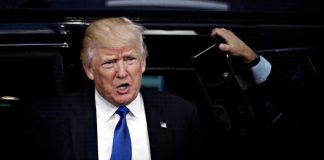
When a president walks into the Supreme Court to watch lawyers argue over the meaning of twelve old words, you know the fight is really about what it means to be an American.
Story Snapshot
- Trump’s birthright citizenship executive order turns a dusty constitutional phrase into a live grenade.
- The Supreme Court now must choose between a century of precedent and a harder-edged view of national loyalty.
- Both sides claim to defend the Fourteenth Amendment, but they invoke radically different histories.
- The ruling will shape immigration, federal power, and the political map for decades.
How Trump Turned Twelve Words Into a Constitutional Street Fight
Donald Trump did not stumble into this battle; he spent years telling voters that “anchor baby” citizenship was a magnet for illegal immigration and a “disgrace” that Congress was too timid to fix. His 2025 order, “Protecting the Meaning and Value of American Citizenship,” declared that children born here to illegal immigrants or short-term visitors would no longer be treated as citizens going forward, and it directed agencies to refuse federal recognition of that citizenship status. That order guaranteed a Supreme Court showdown.
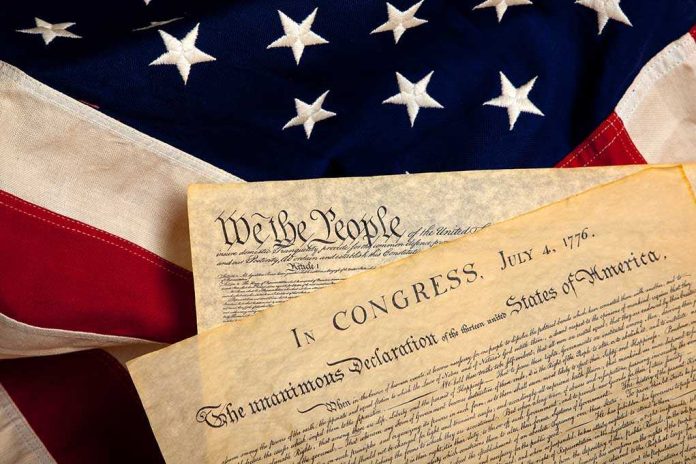
The legal fuse runs through fourteen familiar words in the Fourteenth Amendment: “all persons born or naturalized in the United States, and subject to the jurisdiction thereof, are citizens.” Trump’s lawyers argue that “subject to the jurisdiction” is not just geography but allegiance—that full political jurisdiction is missing when parents are here illegally or only briefly.[6] That reading would shrink automatic citizenship to children of citizens, permanent residents, and a few others, leaving everyone else to Congress and the bureaucracy.
The Long Shadow Of Wong Kim Ark And A Century Of Practice
Opponents answer with a one-word weapon: precedent. In 1898, the Supreme Court in United States v. Wong Kim Ark held that a man born in San Francisco to Chinese parents who were not United States citizens was, nevertheless, a citizen by birth.[4] That ruling has long been understood across administrations as cementing territorial birthright citizenship for almost everyone born on American soil, with narrow carve-outs for children of foreign diplomats and hostile occupying forces.[3] The federal government has issued passports, Social Security numbers, and voting rolls on that assumption for generations.
Legal advocates note that nothing in the Citizenship Clause text singles out the children of immigrants as a disfavored class.[1] Modern constitutional annotations, used by Congress itself, describe the rule as straightforward: if you are born here and not covered by those narrow exceptions, you are a citizen. Conservative critics of Trump’s order warn that overturning this understanding by executive pen, rather than by constitutional amendment or at least an act of Congress, risks handing unnervingly broad power to future presidents with very different agendas.
Originalism, Loyalty, And Conservative Common Sense
Supporters of Trump’s order invoke originalism: read the words as they were understood in 1868, not in modern law school faculty lounges. They argue that the amendment was crafted to reverse Dred Scott and secure citizenship for freed slaves, whose allegiance and domicile were unquestioned, not to reward the children of people who violated immigration laws or treat a week-long hotel stay as a ticket into the American family.[6] They point to nineteenth-century commentary describing jurisdiction as requiring “complete” political obligation, not mere physical presence.[6]
From a conservative standpoint, that argument resonates with basic border common sense. A sovereign nation should decide who joins the polity, not have that decision made automatically by the happenstance of where a flight happened to land. Skeptics of expansive birthright citizenship warn that automatic status encourages “birth tourism,” strains schools and hospitals in border states, and dilutes the meaning of citizenship as a privilege tied to loyalty and shared obligations, not just geography.[2] They see Trump’s order as restoring a tighter link between citizenship and allegiance.
Fear Of Stateless Babies, Two-Tier Citizens, And A Permanent Underclass
The other side sketches a starkly different future. Child-advocacy and immigrant-rights groups warn that narrowing birthright citizenship would create a legally precarious shadow population of United States-born children who are foreigners on paper, often with weak or disputed ties to any other country. Hospitals and school districts would become citizenship screeners, sorting newborns into two piles: those who get full membership in the only home they will ever know, and those who inherit their parents’ unlawful status and fear.
Analysts also note the bureaucratic chaos. Federal agencies would need to verify the visa category or immigration status of every mother at birth, a task the government struggles to perform accurately even for adult benefit programs.[6] Mistakes would fall hardest on poor families with limited ability to navigate complex appeals. Critics call this a frontal assault on an American promise that, whatever your parents did, the law sees you as an individual, not as a permanent suspect class.[1] That cuts against traditional conservative respect for equal treatment under clear, stable rules.
Why This Case Matters Far Beyond Immigration Politics
The Supreme Court now sits at the fault line between text, history, and practice. On one hand, some justices show interest in Trump’s originalist reading and his claim that the Constitution has been misapplied for decades.[6] On the other hand, even right-leaning jurists have questioned whether a single president can “restore” an alleged original meaning by contradicting a century of precedent plus the settled expectations of tens of millions of citizens whose status no one has previously doubted.
For readers who tune out legalese, here is the real question: Who gets to redefine the American “we”? If the Court blesses Trump’s order, it invites future presidents to redraw the civic boundary without going back to the people for a constitutional amendment. If it strikes the order down, it reaffirms that some questions—who is one of us, for life—sit above day-to-day politics. Either way, birthright citizenship will no longer feel like background noise; it will feel like the country deciding what kind of nation it wants to be.
Sources:
[1] Web – Birthright Citizenship Under the U.S. Constitution
[2] Web – Birthright Citizenship Act of 2025: Bill Summary
[3] Web – 8 FAM 102.3 SUPREME COURT DECISIONS – Foreign Affairs Manual
[4] Web – What Is Birthright Citizenship and Could the Supreme Court End It?
[6] Web – Know Your Rights: Trump’s Birthright Citizenship Executive Order