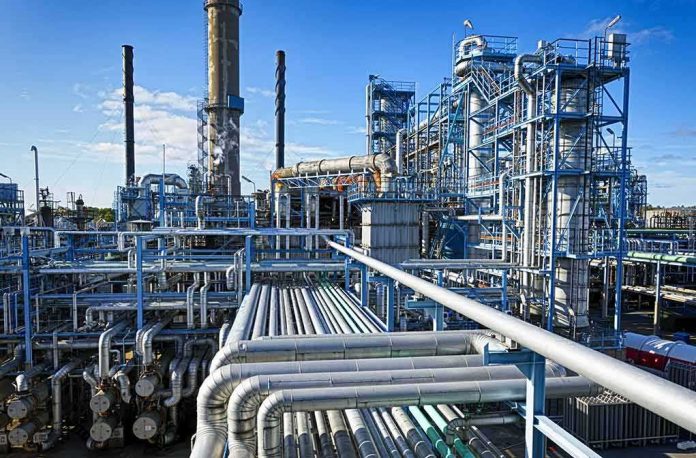
The headline number isn’t the story; the conversion mechanism is. Announcing “control” of 65 billion barrels in Venezuela is geopolitics and geology wrapped together, but only engineering, law, capital, and time turn an underground figure into molecules in an American refinery—and into retail prices at the pump.
At a Glance
- President Trump asserted the United States secured majority control over more than 65 billion barrels of Venezuelan proven reserves—framed as the biggest oil deal in history and a path to lower U.S. gasoline prices.
- Reuters reporting before and after the announcement described a structure aimed at long-term access to specific fields via American operators, guaranteeing supply to the U.S. rather than immediate production.
- The claim to vast reserves is not the same as added supply; Venezuela’s decayed infrastructure, nationalized sector, and sanctions history are the binding constraints.
- Rep. Ro Khanna condemned the arrangement as “colonial” and morally wrong; his critique targets means and legitimacy more than the engineering and market pathway.
What the administration claimed—and what that would have to mean operationally
Trump’s statement cast the pact as a generational energy win: majority control of more than 65 billion barrels of Venezuelan proven reserves, secured at no cost to U.S. taxpayers, that would more than double American reserves and “substantially” lower gasoline prices. Major outlets covered the assertion as a presidential claim without releasing contract text or annexes that would define “control” in a nationalized petroleum system. In parallel, Reuters reported officials were shaping a deal to lock in a slate of Venezuelan oilfields for development by American firms with supply guaranteed to the U.S.—a long-term access architecture, not a tanker-the-day-after scenario. Earlier in 2026, the two governments channeled up to $2 billion of Venezuelan crude into the U.S. market under a tailored sanctions framework, previewing the transactional approach but on a much smaller scale.
For such a structure to work at the scale advertised, five elements must align. First, legal authority inside Venezuela—concessions or joint ventures consistent with national oil law and any constitutional limits on foreign control. Second, sanctions compliance and licensing on the U.S. side, so operators, service companies, and financiers can touch the assets. Third, capital and contractors to rebuild upstream capacity and midstream evacuation. Fourth, marketable crudes—Venezuela’s extra-heavy oils require blending, upgrading, or complex refinery slates. Fifth, credible offtake and payment arrangements that withstand political turnover in both countries. Without published contracts, these remain open variables, not settled facts.
Reserves are not barrels on the pier
Energy professionals draw a bright line between reserves—a probabilistic estimate of geologically discovered, economically recoverable resources under specific assumptions—and production, which is the realized, de-bottlenecked flow that hits the market. Venezuela has the world’s largest headline reserves, roughly 300 billion barrels, yet output collapsed over the past decade due to mismanagement, capital flight, and sanctions; the constraint has been political economy and operating capacity, not subsurface endowment. Analysts have long warned that swelling reserve tallies can coexist with stagnant or falling production; the conversion path is what matters. Treating a reserve booking like immediate, price-moving supply is category error—especially in a province dominated by extra-heavy oil that needs expensive surface infrastructure and reliable logistics to monetize.
Gasoline prices link to crude through an imperfect, time-varying pass-through that depends on refinery utilization, product inventories, regional logistics, and taxes. Even when crude falls, retail prices lag and adjust asymmetrically; when crude rises, the pass-through is faster and larger than when it falls. Any claim of durable, near-term price relief from a future access deal therefore asks the arrangement to overcome both the engineering timeline and retail-price stickiness at once—a tall order, even if field development succeeds.
How this fits the history of Venezuela’s oil sector and U.S. policy tools
Venezuela’s oil system—nationalized upstream, dominated by PDVSA, and repeatedly restructured—has swung between brief openings to foreign partners and retrenchment into state control. Sanctions since 2019 severed financing and service inputs, accelerating decline. By early 2026, Washington experimented with channeling limited volumes under specific licenses; those flows demonstrated that sanctions can be modulated to steer barrels, but they did not repair the underlying industrial base or governance model. A large, U.S.-backed redevelopment would require multi-year capital programs, joint-venture discipline, and political continuity uncommon in the sector’s recent history. This is why pre-announcement briefings characterized the initiative as securing access to fields with U.S. operators and guaranteed supply, not as an instant augmentation of U.S. crude stocks.
If—and it is a consequential if—concession rights, service contracts, and logistics are stabilized, Venezuela can add barrels back. But extra-heavy Orinoco developments hinge on upgrading capacity and reliable diluent. That means either expanding domestic upgraders, importing light hydrocarbons to blend, or relying on complex U.S. Gulf Coast refineries geared for heavy slates. Each option entails financing, trade flows that intersect sanctions policy, and exposure to political risk. In practical terms, the ramp is measured in years, not quarters.
The moral critique and the legitimacy question
Rep. Ro Khanna’s condemnation—“morally wrong,” a throwback to a “colonial model” and “gunboat diplomacy”—does not dispute the specifics of field access or reserve math; it challenges the means and the power asymmetry implied by a U.S.-designed arrangement in a sanctioned, crisis-wracked country. Khanna’s prior statements argue for negotiated settlements and against coercive pressure or broad sanctions that worsen collapse and migration, framing intervention as both unlawful and counterproductive. In this register, even a legally papered energy deal can be judged illegitimate if it relies on leverage born of sanctions and imbalance. The moral lens therefore asks a different question than the engineering one: not “will it flow?” but “should it proceed on these terms?”
For readers trying to reconcile the two frames: legitimacy risks bleed into operational risk. Deals branded as imposed or unconstitutional can be unwound by courts, parliaments, or the next government, undermining project finance and supply guarantees. A durable arrangement typically requires not just signatures, but domestic political buy-in that survives electoral cycles.
"Trump claims US firms have secured majority control of 65bn barrels of Venezuelan oil reserves at no cost to taxpayers, a deal he says could double US reserves and cut fuel prices. Economist Ed Hirs doubts the claimed "biggest oil deal in history" will materialise."
Attention!… pic.twitter.com/bemZDNFThR
— Fernando Ruano Faxas (@RuanoFaxas) August 29, 2026
What would constitute proof of concept—and what it would and would not change
The verifiable path from claim to consequence is straightforward to define, if hard to execute. Publish the executed agreements and annexes: field lists, operators, equity, offtake rights, fiscal terms, dispute resolution, and stabilization clauses. Show the development plans and funding—capex schedules for wells, gathering, upgrading, and export terminals. Identify the sanctions licenses and compliance protections that keep service firms and lenders in the room. Then watch for physical signals: rig count, upgrader utilization, monthly liftings to the U.S. Gulf Coast, and refinery runs. If those metrics move in tandem, the access claim is translating into supply.
Even then, temper expectations about retail price relief. Additional heavy barrels into an already well-supplied Gulf Coast compete with other crudes and blendstocks; they influence regional differentials more than the global crude benchmark. Over time, sustained incremental supply can ease import costs and chip at pump prices. But the idea that a reserves access deal, however large on paper, will by itself “substantially” lower gasoline prices for all Americans is a political promise facing the physics of time-to-first-oil and the economics of pass-through. The stakes are real—energy security favors diversified, contract-secured flows—but the scoreboard will be written in cargoes and project milestones, not in superlatives.
Sources:
thegatewaypundit.com, bbc.com, npr.org, aljazeera.com, reuters.com, businessinsider.com, podscripts.co, tunein.com