
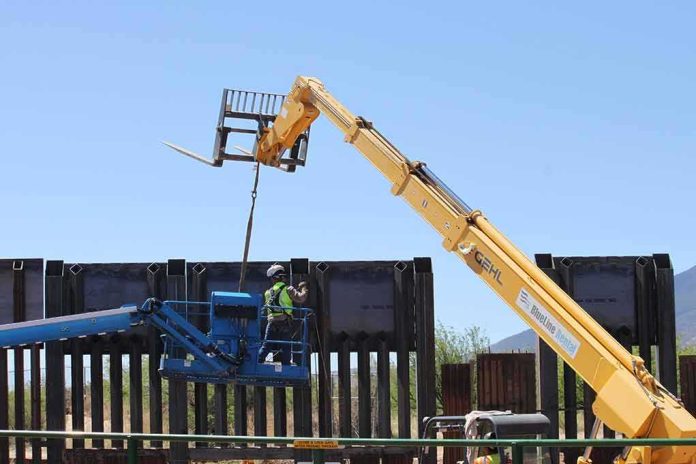
The Supreme Court’s stay in the Big Bend border-wall case is not a merits victory—it is a constitutional tutorial in who decides what during litigation: trial judges test claims, appellate courts correct them, and the justices police the status quo when the balance of harms and likelihood of success make an interim pause the wiser course.
The Short Version
- The Court temporarily lifted a district court’s injunction, allowing construction to proceed while the parties fight over DHS’s statutory waiver authority.
- The government argues Congress expressly empowered DHS to waive “all legal requirements” to expedite border barriers under IIRIRA Section 102, and that delay harms border operations.
- Challengers invoke the major-questions doctrine and say Big Bend is not an “area of high illegal entry,” so sweeping waivers exceed the statute.
- This is an interim ruling: the stay changes on-the-ground reality now but leaves the hardest questions—statutory scope, major-questions limits, and reviewability—for the merits.
What the stay actually does—and does not do
On the emergency docket, the Supreme Court stayed a preliminary injunction that had halted Big Bend wall construction. That stay restores the government’s ability to proceed while the case moves forward; it is not a final judgment on DHS’s authority or the challengers’ constitutional theories. Stays turn on familiar factors—likelihood of success, irreparable harm, balance of equities, and the public interest—and the Court’s unsigned disposition signals only that, as between freezing a national project and maintaining congressional design while arguments continue, the latter prevails for now.
The administration asked for precisely that: short-term relief to avoid what it called “baseless” disruption to border operations and to preserve Congress’s chosen framework for expedited construction. The justices granted the stay and declined to summarily reverse the district court, underscoring that merits resolution will follow the ordinary pathway rather than the compressed tempo of the shadow docket.
The statute at the center: Section 102’s unusual delegation
The legal fight turns on Section 102 of the Illegal Immigration Reform and Immigrant Responsibility Act (IIRIRA), as amended by the REAL ID Act. Congress gave the Homeland Security secretary two unusual tools: authority to build barriers and roads in areas of high illegal entry, and authority to “waive all legal requirements” the secretary deems necessary to ensure expeditious construction. That waiver power is extraordinary in modern administrative law; Congress also curtailed judicial review for many such decisions. The administration’s emergency filings lean on this text and history, arguing Congress was “hardly shy” about delegating robust, speed-first authority at the border.
DHS has used Section 102 repeatedly across administrations, and its waivers have displaced swaths of environmental and conservation laws in prior projects. The Government Accountability Office has chronicled the breadth of these waivers in different contexts, reflecting Congress’s decision to trade process for speed at the line of sovereignty. Big Bend is not an outlier in mechanism, though the location and the presence of parklands sharpen the controversy.
The district court’s contrary view: major questions and “high illegal entry”
The challengers—environmental organizations and local plaintiffs—pressed two interlocking theories. First, they argued that DHS exceeded statutory bounds because Section 102’s build-and-waive scheme is tethered to “areas of high illegal entry,” which, they said, Big Bend is not. Second, they invoked the major-questions doctrine, contending that suspending dozens of environmental and conservation statutes in a national park represents a consequential policy choice requiring clear congressional authorization. The district court agreed at the preliminary-injunction stage, concluding plaintiffs were likely to succeed on their excess-of-authority claim, and emphasized evidence that Big Bend recorded the lowest rate of illegal entry along the border.
That same court found jurisdiction to hear constitutional claims notwithstanding Congress’s limits on judicial review of Section 102 waivers—an important threshold ruling in a field where Congress narrowed courts’ role but left a lane for constitutional challenges. The interim stay from the Supreme Court leaves those determinations unendorsed and unresolved; they will be tested on appeal with full merits briefing.
Why the Supreme Court stepped in on the emergency docket
Emergency stays are about managing risk during litigation. The government framed the injunction as inflicting immediate operational harm—lost time, disrupted contracts, and exposure in a sector it says must be hardened—whereas the challengers emphasized irreparable environmental, cultural, and recreational injury if construction continues. When the equities are close and the statute reflects a congressional judgment favoring expedition, the Court often opts to preserve the government’s ability to function under that framework pending review. That is the through-line of this order. It does not ratify every waiver or reject the plaintiffs’ evidence; it simply prevents a trial-level view from setting national policy unilaterally during appeal.
This approach also recognizes the institutional posture. Section 102 embeds speed and limits on review. Freezing a project midstream can effectively decide the case by running out the clock. The justices resist that when the government shows a colorable merits position and concrete operational costs—precisely what DOJ put forward here, invoking both statutory text and the history of DHS practice.
Where the real legal dispute lies
Three questions will decide the merits. First, how tight is the statutory tether between “areas of high illegal entry” and the waiver power? If the phrase cabins authority geospatially or empirically, challengers gain traction; if it sets a general programmatic predicate satisfied by DHS determinations sectorwide, the government’s case strengthens. Second, how does the major-questions doctrine map onto an express waiver clause? The government contends a clear textual delegation defeats a major-questions challenge; the plaintiffs answer that breadth without limiting principles is precisely what triggers it.
Third, what is the scope of judicial review? Congress curtailed review of waiver decisions, but courts preserve a constitutional lane; drawing that line—what is reviewable, how deferentially, and on what record—will shape outcomes well beyond Big Bend. Prior litigation has tended to credit DHS’s determinations, but the park setting and the challengers’ evidentiary proffer make this a harder case than routine segments along already developed corridors.
Evidence gaps that will matter on appeal
Both sides face proof problems that appellate judges will notice. The government’s emergency papers stress general border-security imperatives more than Big Bend-specific operational data—encounter trends, response times, smuggling corridors, and the marginal security value of the proposed segment. A more granular record would strengthen the claim that delay imposes irreparable harm in this particular sector. Conversely, the plaintiffs’ narrative of environmental and cultural injury—powerful as policy—must remain tied to statutory limits and the major-questions framework rather than morph into an all-things-considered veto of Congress’s waiver design.
Expect discovery skirmishes over the administrative record and FOIA battles over waiver memoranda, sector maps, and threat assessments. Appellate panels will want specificity: what laws were waived, why each waiver was necessary for expeditious construction, and how DHS evaluated alternatives less intrusive to parklands and private property. That kind of record, more than rhetoric, will decide whether agency action was within the lines Congress drew or an impermissible leap beyond them.
Big Bend, Texas is back on. The Supreme Court lifted the lower court injunction on border wall construction there, and only Justice Jackson noted a dissent. Get the crews moving.
— BONEWITZ🇺🇸🇺🇸 (@bonewitz_SPBG) November 9, 2026
Why the stay is a civics lesson, not a final word
Emergency relief can mislead the casual observer into scorekeeping. Savvy readers should treat it as a process signal. The Court preserved the executive’s ability to act under a contested statute while reserving the hard interpretive work for the merits. If the government ultimately shows that Section 102’s text clearly authorizes the waivers and that DHS acted with reasoned explanation, it will likely prevail. If the challengers persuade appellate judges that “high illegal entry” operates as a real constraint and that major-questions scrutiny applies to the breadth of environmental displacement in a national park, the injunction could return—this time on a firmer legal footing.
Sources:
reuters.com, scotusblog.com, washingtonexaminer.com, winknews.com, courthousenews.com, yahoo.com, azcentral.com