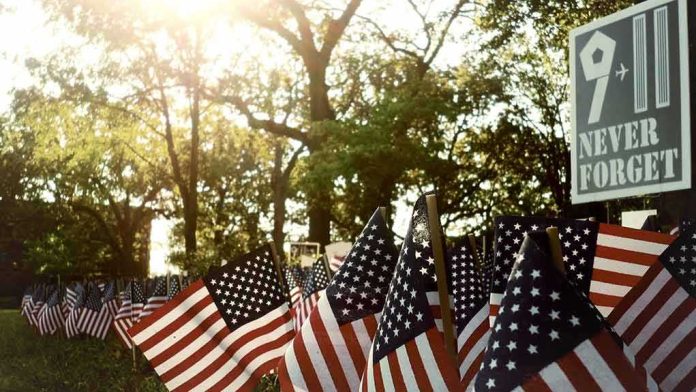
Public memory is not an abstraction in St. Louis; every five years it is made visible, tangible, and walkable on Art Hill, where thousands of American flags turn a civic landscape into a ledger of lives from September 11 and the long war that followed.
At a Glance
- Flags of Valor is a recurring, every-five-years memorial on Art Hill that marks major 9/11 anniversaries with a field of thousands of American flags.
- The tribute honors both the 2,977 killed on 9/11 and service members who died in the subsequent Global War on Terror, each named and individually represented.
- Scale, precision, and volunteer labor define the memorial’s character; organizers assemble and place more than 7,000 flags across the slope of Forest Park.
- The event integrates ceremony and education—name readings, photo boards, and chronological layouts—so families, veterans, and newcomers can locate specific stories.
What the Art Hill memorial is and why it endures
Flags of Valor is not a one-off vigil; it is a designed, recurring act of remembrance staged by the nonprofit America’s Heartland Remembers. On a fixed rhythm, the organization transforms Forest Park’s Art Hill into a topographic archive of loss and service, marking milestone anniversaries of September 11 with a sea of American flags. The 2026 edition—timed to the 25th anniversary—stretches over nine days and is open to the public free of charge. Organizers cast the effort plainly: to remember every person killed in the attacks and to honor each service member who died in the wars that followed, with individual representation and names that visitors can find and read. The official event plan lays out dates, location, and purpose with the clarity of a mission brief.
That clarity extends to the memorial’s grammar. The civilian dead of 9/11 are named and pictured; the military fallen from the Global War on Terror are honored flag by flag. Local and regional coverage consistently emphasizes two features that make the display consequential: its magnitude—among the largest such 9/11 tributes in the country—and the meticulous, volunteer-driven construction that turns symbolism into a navigable experience for families, veterans, and first responders.
How it is built: scale, method, and stewardship
The memorial’s power is inseparable from its logistics. Thousands of flags—often cited in the 7,500–7,700 range, aligning with contemporary counts of U.S. service members fallen in the post-9/11 conflicts—are hand-assembled and precisely placed across Art Hill’s slope. St. Louis outlets have documented the operational choreography: more than a thousand volunteers, grid layouts engineered for alignment, sequential sections that let visitors locate specific names, and name-reading ceremonies that activate the field at night. These are not incidental details; they are the interpretive infrastructure that converts a panoramic spectacle into a site of personal retrieval—a father finding a son’s flag, a reporter locating a friend’s memorial, a veteran tracing a unit’s dead through chronology.
Organizers state that each service member lost in the War on Terror is represented with an individual flag and that the display is chronological, with photographs and identifiers that allow targeted acts of remembrance. That commitment to one-to-one representation—no composite walls of text, no undifferentiated mass—aligns with best practices in contemporary memorial design, which prioritize legibility, wayfinding, and the possibility of intimate encounter within a large public form.
Where this memorial fits in the landscape of 9/11 remembrance
Since 2001, American memorial culture has learned, often through controversy, that how we frame the dead—victims, heroes, citizens, soldiers—shapes not only the narrative of the past but the civic uses of the present. Scholars who study 9/11 commemoration describe the constant negotiation between official narratives and vernacular mourning, between national scale and local voice. The National September 11 Memorial institutionalized one model; community-built projects like Art Hill represent another, where volunteers carry the weight of assembly and interpretation on behalf of a region’s memory.
Flags of Valor collapses two frames that are often kept apart: the immediate catastrophe of the attacks and the two decades of conflict that followed. That coupling is not decorative. It posits a single arc—from New York, Arlington, and Shanksville to Iraq, Afghanistan, and beyond—and invites visitors to move physically through it, reading names from 2001 and names from later years in contiguous space. The resulting message is capacious without being vague: grief for civilians; honor for those who served and died; and, crucially, continuity between the day itself and its consequences.
The cadence of return: why every five years matters
Annual rites risk becoming rote; once-in-a-generation monuments risk detachment. By returning every five years, the Art Hill memorial keeps pace with both private grief and public history. Families can plan to gather in a predictable cycle, schools can fold site visits into curricula at meaningful anniversaries, and the design can adapt as datasets and interpretive needs evolve. The five-year cadence also distributes the heavy lift of volunteer mobilization and fundraising while ensuring the display remains an event—anticipated, communal, and large enough to command regional attention.
This periodicity also solves for a practical truth: the numbers change. As the official tallies of service members lost in the Global War on Terror were updated over two decades, the memorial’s counts and placements adjusted accordingly, and local reporting reflected those revisions with differing flag totals across years. Variance of a few dozen flags between editions is not a flaw; it is maintenance of fidelity to the record in a living memorial practice.
More Than 7,500 American Flags Cover St. Louis’ Art Hill to Honor 9/11 Victims
ST. LOUIS: More than 7,500 American flags now cover Art Hill in St. Louis, creating a powerful tribute as the United States marks the 25th anniversary of the September 11 terrorist attacks.… pic.twitter.com/tS1NzHgEDJ
— CSB News USA (@csbnewsus) September 12, 2026
What visitors encounter on the hill
To the eye, the display reads as scale first: stripes and stars undulating in wind across a great green slope. But within minutes the experience narrows to particulars—names on boards, photos mounted with care, dog tags that resonate with the veterans who walk among them. The site is designed for movement and pause: wide lanes allow processions and school groups; quiet rows offer space for private recollection. Program elements—candlelight vigils, coordinated name readings, and guided orientations—structure time so that the memorial is not merely seen but used. Families report gratitude for finding their person; volunteers speak of service; first responders recall the day’s immediacy and its aftermath. The form is simple; the encounters are not.
Why it matters now and will matter later
Public memory ages unevenly. For those who lived 9/11, the day remains immediate; for those born after, it is history quickly abstracted by distance. The Art Hill memorial narrows that gap without preaching. It hands visitors a map—literal and moral—by which to connect individual stories to national consequence. It signals that civic remembrance is not the government’s job alone; communities can marshal precision, dignity, and scale when it counts. And by insisting on the link between the attacks and the long war, it preserves a narrative spine that might otherwise fragment with time.
The measure of such a memorial is not its novelty but its reliability. Flags of Valor has become a St. Louis institution because it returns, because it is meticulous, and because it trusts the public with names, photographs, and the sober arithmetic of loss. In a country where memory often dissolves into spectacle, Art Hill’s flags recode spectacle as stewardship—large enough to stop you, granular enough to move you, and built to be found again.
Sources:
facebook.com, stlamerican.com, stlmag.com, hoodline.com, flagsofvalorstl.com, yahoo.com, citylifestyle.com, furnituretoday.com, keyt.com, academic.oup.com, journal-veterans-studies.org