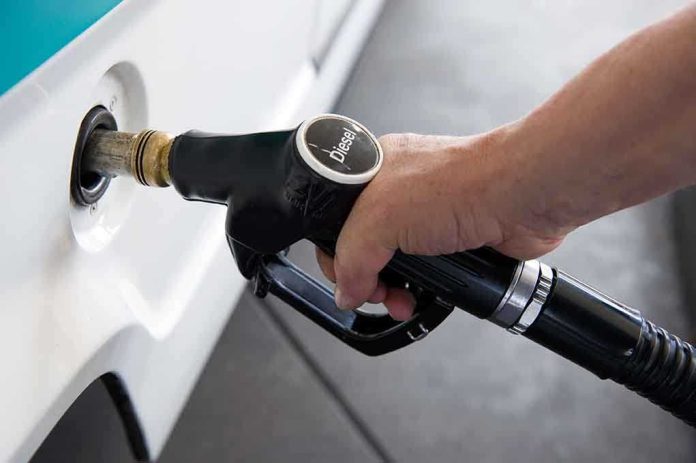
When diesel jumps from an annoyance to an $8 gut-punch, the “hidden” cost of everything suddenly becomes the only story that matters.
Story Snapshot
- Reports and video coverage in late March and early April 2026 pointed to record-high diesel prices in California, with Los Angeles-area averages shown in the mid-$7 range.
- A separate clip headline suggested Bay Area diesel pushed beyond $8, but the available research material does not provide station-by-station confirmation.
- Diesel spikes hit the real economy first: trucking, agriculture, construction, port logistics, and anyone buying food delivered by a diesel vehicle.
- California’s pricing pain tends to amplify when supply tightens because the state’s fuel system runs less like a national market and more like a gated community.
$8 Diesel Is a Consumer Tax That Never Gets Voted On
California’s diesel spike story plays out the same way every time: drivers stare at the sign, then everyone else pays later. Diesel doesn’t just move commuters; it moves groceries, building materials, farm inputs, and retail inventory. When the price climbs fast, businesses don’t “eat” that cost out of kindness. They ration, they delay, and they raise prices. That’s how a fuel problem turns into a household budget crisis.
The research provided includes video coverage showing Los Angeles-area diesel averaging roughly $7.56 to $7.68 per gallon as of April 2, 2026. Another clip title claims the San Francisco Bay Area exceeded $8, but the limited dataset doesn’t confirm exact locations, dates, or how long that threshold held. That distinction matters. Prices can briefly spike at a few stations due to local outages, then retreat, while headlines live forever.
“Gulf Shock” Sounds Like a Single Event, but Fuel Spikes Usually Travel in a Chain
The premise mentions a “Gulf Shock,” yet the available material doesn’t define it. That’s a problem because diesel surges typically come from a chain of causes, not one villain. A disruption in global crude supply, refinery outages, shipping constraints, and sudden demand changes can all tighten the market. The Gulf Coast matters because it’s a refining hub; if supply or logistics hiccup there, the ripple can reach the West Coast fast.
California often feels those ripples harder because it cannot always swap barrels seamlessly with the rest of the country. If a refinery problem hits, importing replacement fuel is not as simple as redirecting a truckload from a neighboring state. The state’s fuel specifications and limited in-state refining capacity can make “quick fixes” slower and pricier. Everyday people experience it as a mystery surcharge. Industry veterans experience it as a predictable fragility.
Why California’s Fuel System Can Magnify Pain When Supply Tightens
California’s leaders frequently promise to “fix” price spikes, yet households keep getting surprised. The common-sense explanation is that markets punish systems with fewer options. When supply is abundant, complexity hides. When supply tightens, complexity bills you. Conservatives tend to look for incentives: policies that discourage new refining investment, raise compliance costs, or reduce flexible supply can leave the state with less margin for error.
That doesn’t prove any one policy “caused” a specific spike. It does frame why residents feel trapped. When the government adds layers—fees, mandates, enforcement regimes—the cost structure stiffens. In a stable period, that stiffness looks like management. In a volatile period, it looks like failure. A family filling up a diesel pickup for work doesn’t care which agency wrote which rule; they care that the system produced an $8 moment.
The First Domino to Fall Is Freight, and the Last Domino Is Your Fridge
Diesel pricing hits different sectors with different speed. Freight carriers feel it immediately and start adding surcharges. Farmers and ranchers feel it at planting and harvest because equipment, pumps, and transport drink diesel. Construction firms feel it through generators, heavy machinery, and deliveries. Then retail feels it through inbound logistics. By the time consumers notice a few extra dollars on staples, the spike has already traveled the supply chain.
Consumers also underestimate how quickly businesses change behavior when fuel becomes unpredictable. A carrier can reroute loads, reduce idle time, or decline less profitable lanes. Those are rational decisions, but they reduce service and raise costs for communities that already sit at the end of the distribution line. The political argument gets loud at the pump, yet the quiet damage shows up later: fewer deliveries, higher bids, deferred projects, and shrinking purchasing power.
Sources:
California passed a law to curb spikes in gas prices. So …
California Diesel Prices Top $7 a Gallon to Hit Record High