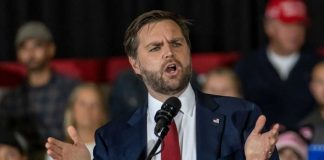
Hakeem Jeffries told Black athletes to treat certain Southeastern Conference recruiting pitches like a picket line, declaring silence from universities “complicity” in what he called Jim Crow-like redistricting [1].
Story Snapshot
- House Democratic Leader Hakeem Jeffries urged a boycott of Southeastern Conference institutions in states using disputed maps [1].
- He framed Republican redistricting as an unprecedented attack on Black political representation [1].
- He claimed six Black-represented congressional districts have already been targeted [2].
- The National Association for the Advancement of Colored People and the Congressional Black Caucus aligned on pushback, including an athlete response [3].
Jeffries escalates redistricting fight into a sports battleground
House Democratic Leader Hakeem Jeffries said the nation faces “an unprecedented attack on Black political representation,” and he endorsed a boycott by Black athletes of institutions in the Southeastern Conference located in states with disputed maps [1]. He described the tactics as “Jim Crow-like” and argued that universities’ refusal to speak out amounts to complicity [1]. He tied the campaign to targeted districts, asserting Republicans “have already targeted six congressional districts represented by African-Americans,” though he did not enumerate them in the cited remarks [2].
Jeffries placed the boycott within a civil-rights narrative that reaches back to literacy tests and property requirements once used to suppress Black voters, invoking Louisiana’s history and long-running litigation fights [2]. He argued the moment warrants an “unprecedented response” because institutional channels have moved too slowly to prevent near-term election consequences [1]. He contended that athletic brands and recruiting pipelines in the South wield leverage that universities and state leaders cannot easily ignore when television money and roster talent are at stake [1].
The coalition and the missing paperwork
The National Association for the Advancement of Colored People and the Congressional Black Caucus publicly aligned on pushing back, with media summaries tying the response to college sports pressure in Southern states [3]. The provided record, however, does not include a formal resolution text from either organization or signed statements from athlete groups endorsing a boycott [3]. The absence of published athlete coalitions or campus governance votes leaves the operational path unclear, especially on logistics like transfer timing, scholarship security, and potential retaliation protections.
Jeffries’ assertion that six Black-represented districts were targeted invites a document trail—maps, legislative journals, demographic analyses, and district performance simulations—to evaluate whether the moves reflect partisan hardball or racial gerrymandering under federal law [2]. The sources in hand include rhetoric and historical analogies but not the shapefiles, precinct data, or expert reports that typically decide Section 2 of the Voting Rights Act cases or constitutional claims. Without those, the claim’s legal footing remains asserted rather than demonstrated in this packet [1].
Legal timing, practical leverage, and conservative skepticism
Jeffries referenced a Supreme Court environment in which relief in at least one case would not meaningfully affect the immediate election cycle, implying that contested lines may govern near-term contests absent a new order [2]. That timing argument explains the urgency behind using athletes as leverage; if the courtroom clock runs slow, a recruiting boycott is a pressure tactic with broadcast-visible consequences this season, not in 2028. Yet that same timing reality counsels restraint: courts, not pressers, determine whether maps are illegal, and evidence, not epithets, moves judges [2].
Hakeem Jeffries joined the Congressional Black Caucus and NAACP's call for black athletes to boycott SEC schools in states with ‘Jim Crow-like’ redistrictinghttps://t.co/qDWWCA0ET1 pic.twitter.com/6EgWSLZV8z
— TONY V (@_MTMTE) May 20, 2026
Conservative readers will see two sorting questions. First, is the remedy proportionate to the evidence? If the maps truly dilute votes on racial lines, present the compactness metrics, polarized voting studies, and alternative plans that meet legal tests. Second, why conscript student-athletes as enforcers of political accountability when university leaders, legislators, and courts own the authority? If silence from universities is complicity, then transparency cuts both ways: publish the maps, the data, and the standards, district by district, so common sense can judge the case on more than applause lines.
Sources:
[1] Web – “WE ARE HERE TO BOYCOTT THESE JIM CROW-LIKE, RACIALLY …
[2] YouTube – Jeffries: Republicans Are Pushing A ‘Return To Jim Crow …
[3] Web – NAACP, Congressional Black Caucus urge college sports boycott in …