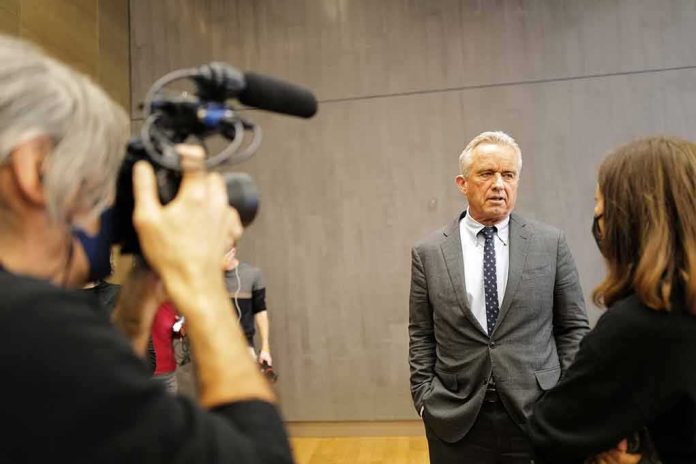
When a sitting Health and Human Services secretary steps behind a lectern at Children’s Health Defense, it is not just another speech on a crowded D.C. calendar; it is a signal about priorities, alliances, and how a top health official intends to navigate the country’s most polarizing public‑health fault lines.
At a Glance
- Children’s Health Defense hosted a one‑day “CHD in DC” conference at the Grand Hyatt Washington, with Robert F. Kennedy Jr. billed to deliver a keynote.
- Public listings and reporting identify the date, venue, and Kennedy’s role on the program.
- Kennedy’s remarks track themes he has championed for years: “health freedom,” critiques of regulatory capture, and a focus on chronic disease in children.
- The appearance sits inside a long tradition of ethics‑sensitive speaking by federal officials at nongovernment events, where both content and context matter.
What happened: the conference, the room, the role
Children’s Health Defense staged a one‑day “CHD in DC” conference at the Grand Hyatt Washington on Thursday, September 17, 2026, with the venue, date, and format publicly posted by the organizers. The event page framed a full day of sessions and networking oriented around children’s health and what the group terms “health freedom.” Within that program, Robert F. Kennedy Jr. was listed as a featured speaker, positioned to deliver a keynote‑style address that organizers described in schedule material as a wide‑lens survey of children’s health and civil liberties around medicine. Independent reporting ahead of the event likewise described Kennedy as set to keynote the Washington conference hosted by the organization he previously led.
The through‑lines of Kennedy’s public rhetoric made the content direction predictable. In recent appearances he has cast rising rates of pediatric chronic conditions as a policy failure and linked them to an industrialized food system and environmental exposures; he has also fused that diagnosis to a critique of federal public‑health institutions and their relationships with regulated industries. Coverage of his remarks at allied gatherings has highlighted those themes repeatedly, including his contention that ultra‑processed foods contribute to a pediatric chronic disease “epidemic”.
Why this venue matters: CHD’s identity and the signal of a keynote
Children’s Health Defense is best known for adversarial stances toward vaccines and the agencies that evaluate and recommend them; that identity shapes how an HHS leader’s presence on its stage will be read. A keynote is not a panel seat on a crowded dais; it is the marquee slot. In Washington, audiences tend to interpret it as endorsement of the forum’s legitimacy, even if the content is framed as a dialogue with critics. That is why, inside government, external speaking invitations receive a level of ethics scrutiny disproportionate to their surface simplicity. Multiple executive‑branch guides instruct officials to examine who controls the agenda, whether the organizer is a prohibited source, and whether the appearance risks use of public office to privilege a private organization; they also bar outside compensation for official‑duty speaking and caution against even the appearance of preferential access.
Against that backdrop, a headliner at a CHD gathering communicates more than the words delivered. To movement allies, it telegraphs access and alignment; to institutionalists, it poses the perennial question of whether engagement normalizes a group whose core claims often run against prevailing evidence. That tension is not new, but when the speaker holds the nation’s top health policy portfolio, the stakes scale up.
The policy frame Kennedy brings: chronic disease, oversight, and “health freedom”
Kennedy’s argument architecture tends to start with burden and trend: an insistence that American children face rising chronic illness, paired with a claim that the status quo in food, chemicals, and medicine is not serving them well. He links that to regulatory capture—the idea that agencies intended to protect the public are overly responsive to the industries they oversee—and to civil‑liberties concerns that surged during COVID‑19. Those planks resonate with the conference’s audience, which blends vaccine‑skeptical advocates with broader critics of modern public‑health practice. In adjacent appearances he has zeroed in on nutrition and industrial processing as upstream levers, a move that allows him to argue for health gains outside the vaccine battlefield while keeping his core critique intact.
Strategically, that emphasis serves two purposes in a keynote setting. First, it offers a unifying problem definition—children’s health adversity—that can recruit listeners who do not identify with anti‑vaccine rhetoric but are open to food‑system or environmental reform. Second, it preserves the conference’s insurgent brand by casting mainstream institutions as lagging indicators of public concern. For an HHS secretary, putting that case from the stage reframes the relationship with the agency’s own portfolio: nutrition guidance, FDA oversight, NIH research funding, and CDC surveillance all come into play.
How we got here: the arc from advocacy to cabinet office
Children’s Health Defense has, for years, intertwined litigation, media, and convenings to contest orthodoxy on vaccines and other health policies. Kennedy’s leadership role there prior to entering federal office stitched his biography to the group’s identity. Reporting around the D.C. event underscored that continuity, describing the keynote as a kind of homecoming—the first overt embrace of CHD from the HHS perch. That narrative draws strength from straightforward, on‑the‑record facts: the public agenda, the venue, and the billed speaker.
In governance terms, the move fits a familiar Washington pattern: an official long associated with an advocacy community tests whether—and how—he can engage that community from inside the bureaucracy. Ethics frameworks do not bar such engagement; they shape it. The controlling questions are capacity, compensation, and control. Was the official speaking in an official capacity, was the event’s agenda controlled by an outside entity, and were any benefits offered beyond what rules allow? Federal guidance makes the lines explicit: no honoraria or travel pay for official‑duty speaking, no use of title to advance private interests, and heightened caution when the host is a frequent party before the agency.
Competing readings of consequence: engagement, normalization, or strategic outreach?
Serious observers will split on the net effect of the keynote, and the divide tracks values more than data. One camp reads the appearance as normalization—proof that a group defined by opposition to consensus immunization policy now enjoys inside track access. Another sees strategic outreach: a senior official taking the toughest room to prosecute a case for his priorities—nutrition reform, transparency, and recalibrated risk communication—while absorbing criticism. The facts of the listing and the speech do not resolve that interpretive question; they define the stage on which it plays out.
What matters for policy is what follows. If the speech is a prelude to rulemaking and research priorities that emphasize food quality, environmental exposures, and post‑marketing surveillance for medical products, then the keynote functioned as scene‑setting. If it yields advisory‑committee appointments and grantmaking that mirror CHD’s worldview on vaccines, the reading will tilt toward normalization. The text of executive‑branch ethics and speaking rules will frame the permissible scope of that follow‑through, particularly around avoiding preferential treatment or implied endorsement of private organizations by virtue of office.
RFK Jr. Promises More Policy Changes, Vaccine Injury Focus In Speech To CHD https://t.co/uhbUA1Q0Cf
— InsideHealthPolicy (@InHealthPolicy) September 17, 2026
The durable takeaway
The Washington conference and Kennedy’s role at its center are not in dispute: a public schedule, mainstream coverage, and the group’s own materials align on the who, where, and when. The significance lives in the why. Cabinet‑level time is the scarcest currency in government; where it gets spent is policy in miniature. By spending it at CHD, Kennedy put a marker down about the debates he intends to own—children’s chronic disease, regulatory independence, and the boundaries of “health freedom”—and about the audiences he is willing to court to move them. The rules governing such appearances are clear. The outcomes, as always, will be measured in what the department does next.
Sources:
facebook.com, childrenshealthdefense.org, nbcnews.com, thekennedybeacon.substack.com, economictimes.indiatimes.com, politicalwire.com, statnews.com