
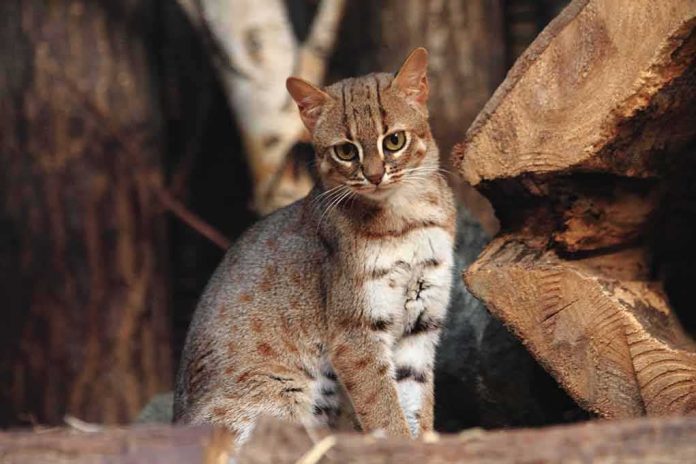
A cat smaller than the one curled up on your sofa has just rewritten a line in the taxonomic record books that had not moved in a hundred years — and it did so by strolling out of Bolivia’s cloud forest and, in one telling case, a roadside rescue.
Key Points
- Scientists formally described Leopardus tilcayo, a small spotted wild cat from Bolivia’s Yungas cloud forest, in the journal Current Biology on September 17, 2026.
- It is the first living cat species formally named and described anywhere in the world in more than a century, according to the study team and multiple outlets covering it.
- Whole-genome comparison of 38 Leopardus specimens showed the animal split from its closest tiger-cat relatives roughly 1.4 million years ago.
- The name preserves “tilcayo,” the term used by local Bolivian communities for the animal long before science caught up to them.
- An international team led by geneticist Eduardo Eizirik of PUCRS in Brazil, with Paola Nogales-Ascarrunz of Universidad Mayor de San Andrés, carried out the five-year investigation.
What Was Found, and Where
The animal at the center of this story is unassuming by design. Tiger cats — the small, spotted felines of the genus Leopardus that range across Central and South America — have long been treated by taxonomists as a tidy handful of look-alike species. Leopardus tilcayo lives in the Yungas, the steep, mist-wrapped transitional forest that runs down the eastern slopes of the Bolivian Andes between the high Altiplano and the Amazon lowlands. It is smaller than a house cat, densely spotted, and by every account from the researchers and the outlets that covered the finding, easy to mistake for something already known to science, which is precisely why it went unrecognized for so long.
Local communities in the region did not need a peer-reviewed paper to know the animal was there; they had a name for it. The Guardian and Reuters both note that the formal scientific name deliberately retained that local word, tilcayo, rather than replacing it with a Latinized honorific or a geographic tag, as taxonomists often do. That choice matters more than it might first appear — it is an acknowledgment that indigenous and rural knowledge frequently identifies distinct animals long before institutional science has the genetic tools to confirm it.
How Genomics Settled a Century-Old Question
The mechanism behind this discovery is not a field sighting of something wholly unknown; it is a genomic untangling of a group that looked too similar to separate by eye alone. The Current Biology paper, led by Jonas Lescroart and Eduardo Eizirik’s team, compared complete genomes from 38 Leopardus specimens — a mix of museum material and living-animal samples — and used that comparison to resolve what had been treated as a single tiger-cat complex into five distinct species. Leopardus tilcayo emerged as one of those five, having diverged from its nearest relatives an estimated 1.4 million years ago, a divergence deep enough to count as a separate species rather than a regional variant.
This is the pattern practicing mammalogists recognize well: a “new species” announcement is rarely the sudden sighting of an animal nobody had ever seen. It is far more often a taxonomic resolution — DNA sequencing, museum voucher specimens, and comparative morphology combined to formally split a group that field biologists had already suspected was not as uniform as older classification systems assumed. That is exactly the frame the study’s own methodology supports here, and it is worth understanding, because it explains why a housecat-sized animal already familiar to Bolivian villagers could still make global headlines as a scientific first.
A Century Without a New Cat
Reuters and the BBC both frame the finding in identical terms: this is the first time a new living cat species has been formally named and described in more than a hundred years. That is a meaningful benchmark in mammalogy, a field where large-bodied, charismatic carnivores are assumed to be thoroughly cataloged. Cats are among the most intensively studied mammal families on earth — zoos, geneticists, and wildlife agencies track nearly every known felid population — which makes a genuinely new species designation rare enough to draw attention well beyond specialist journals. The last comparable event predates modern genomic sequencing entirely, which underscores how much of this discovery owes to the technology rather than to a lack of prior fieldwork.
One detail circulating in coverage of the story humanizes the science: at least one tilcayo individual came to researchers’ attention after being found as a kitten along a roadside and taken in by a Bolivian wildlife sanctuary, initially presumed to be an ordinary tiger cat until genetic testing said otherwise. It is a reminder that taxonomic breakthroughs sometimes begin not in a remote transect through primary forest but in the mundane business of rescuing an animal that looked, to untrained eyes, entirely unremarkable.
Scientists have discovered a new wild cat species hiding in plain sight in Bolivia! 🐆😳 DNA tests show it’s been evolving separately for about 1.4 million years. Nature still holds many secrets. 🌍#Wildlife #Nature #DidYouKnow pic.twitter.com/7uamcI1cv1
— Dimmanat daily (@dinmanat) September 18, 2026
Why the Yungas Matters Now
The Yungas cloud forest is not a stable backdrop for this story; it is under real pressure from agricultural expansion, coca cultivation, and road development, and a species confirmed to occupy a narrow band of that habitat inherits conservation stakes the moment its name is published. Formal description is the gateway to conservation status assessments — IUCN listings, national protections, habitat designations — none of which can proceed until an animal has a recognized scientific identity. Leopardus tilcayo’s naming is therefore not simply an academic tidying-up exercise; it is the opening move in whatever protective framework Bolivian authorities and international conservation bodies choose to build around a cat that, until this year, had no formal claim to exist at all.
Sources:
youtube.com, theguardian.com, sci.news, reuters.com, ua.news, uk.news.yahoo.com, gulfnews.com