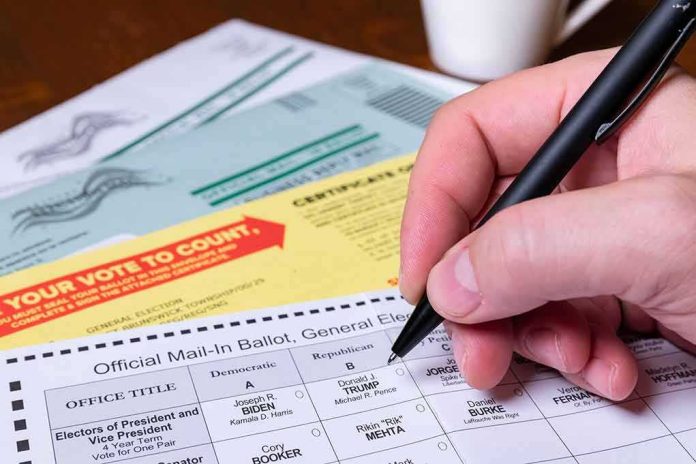
Ballots are designed to convert voter intent into an outcome; schemes that mimic a frontrunner’s name weaponize that design flaw. The Alaska “two Dan Sullivans” episode is a case study in how modern campaigns, ranked-choice rules, and legal gray zones can intersect to manufacture confusion without necessarily breaking a statute—and why prosecutors, courts, and election administrators ended up focused on three separate questions: did operatives recruit a same-name candidate, is that unlawful, and did it actually change votes.
The Short Version
- Federal filings and major outlets describe a coordinated effort by operatives linked to Mary Peltola’s orbit to recruit a same‑name “Daniel J. Sullivan,” who qualified for Alaska’s general election ballot.
- The Justice Department alleged the candidacy’s “sole purpose” was to benefit Peltola and sought to condition certification to protect potentially confused votes; Alaska’s governor launched a state investigation.
- Peltola, her campaign, the DSCC, and Daniel J. Sullivan all denied involvement or knowledge, and state courts upheld the challenger’s ballot eligibility.
- Ranked-choice voting can blunt but does not eliminate spoiler dynamics; same-name tactics exploit a different vulnerability: name-recognition confusion at the point of selection.
What is actually alleged—and by whom
The core factual spine rests on two strands of evidence. First, reporting built on interviews, messages, and documents said operatives connected with Alaskans for Mary and senior DSCC aides sought out similarly named candidates—including a schoolteacher named Daniel J. Sullivan—to siphon support from incumbent Senator Dan Sullivan. The teacher then advanced from the primary to the ranked-choice general ballot, creating a concrete channel for misattribution. Second, the U.S. Department of Justice filed suit in federal court seeking to prevent certification of any outcome tainted by voter confusion and asserted that the non‑incumbent Sullivan’s “sole purpose” was to benefit Peltola. DOJ later amended its complaint to allege the campaign and DSCC knew the candidacy’s purpose and misled the court about that knowledge.
Alaska’s governor directed state public safety officials to investigate whether the recruitment crossed lines in Alaska law. The move signals that, at minimum, state authorities saw the allegations as specific enough to merit a criminal and civil review.
The counter-claims: denials, not disproof
Against that record, Peltola stated she knew only two names on the ballot—hers and the incumbent—and said she was “not interested in tricking voters.” Her campaign, the DSCC, and Daniel J. Sullivan each denied recruiting, involvement, or coordination. Those are categorical denials, not just hedged statements, and they matter; but they are not, by themselves, affirmative evidence that refutes documentary reporting or sworn agency allegations.
Two institutional facts temper the government’s theory. First, Alaska courts upheld Daniel J. Sullivan’s eligibility. An Alaska Superior Court, affirmed by the state Supreme Court, rejected the notion that a candidate must prove “good faith” as a condition of ballot access—a reminder that ballot qualification is a threshold rules question, not a referendum on motives. Second, nothing in the public record cleanly proves that confused votes were cast or determinative; DOJ’s remedy was prophylactic—segregate and protect potentially confused ballots—rather than a claim of already‑proven miscount.
Mechanics: how a same‑name strategy exploits the system
Same‑name recruitment is not clever in a game‑theory sense; it is crude and practical. It leverages voter behavior under cognitive load. Ballots are scanned quickly, many voters rely on partial cues—party, incumbency, and, crucially, name recognition. When two near‑identical names appear, especially in lower‑information environments, a nontrivial share of voters will select the wrong one or fail to fully disambiguate. Ranked‑choice voting (RCV) can mitigate classic spoiler dynamics by reallocating preferences, but it does not cure selection errors at the first mark; if a voter intending to back the incumbent marks the homonymous challenger first and then exhausts or misranks, the corrective mechanisms are limited. Empirical syntheses and formal analyses of RCV repeatedly show spoiler effects are reduced but not eliminated.
In Alaska’s format, the top four advance to a general election with instant runoff tabulation. That architecture increases the odds a deliberately recruited same‑name entrant survives the primary, placing the confusion risk where it matters most—the high-salience final ballot. That is precisely what happened with Daniel J. Sullivan’s qualification for the general.
Law versus ethics: what rules are implicated
Three legal layers govern this terrain. Ballot access statutes are formal and administrable: age, residency, filing fees, signatures. Alaska’s judiciary has made clear that subjective “good faith” motives are not an access gate; as long as the paperwork and thresholds are satisfied, the name goes on. That is why the courts left the candidacy in place.
Second, fraud and conspiracy provisions address affirmative deception—false filings, forged signatures, covert in‑kind support, or disinformation. If operatives recruited a decoy and provided undisclosed material assistance, money, or coordination that violated campaign‑finance law, that is cognizable; it is also provable, if true, through bank records, vendor invoices, and communications trails. That is where a DOJ theory can ripen from allegation to charge. The amended complaint’s claim that litigants misled a federal judge raises an even starker line: candor to the tribunal is obligatory, and misleading the court is sanctionable.
Third, election administration remedies—segregating ballots, post‑election surveys, or audit‑level modeling—address the downstream question: did confusion occur at a measurable scale? Courts are appropriately cautious here; protecting ballots without disenfranchising lawful voters requires precision that is often unavailable in real time. DOJ’s ask to condition certification reflects that tension.
Evidence thresholds: what would actually settle the dispute
The reporting describes messages, documents, and witness accounts; DOJ says the purpose was to benefit Peltola and that key actors knew it. That is serious, but the difference between a troubling story and a prosecutable case is corroboration with provenance: dated communications tying campaign or DSCC personnel to recruitment, financial flows from aligned entities to the decoy campaign, travel and vendor records showing coordinated execution, and sworn testimony that bridges any remaining gaps. Conversely, the defense position strengthens if the communications chain ends with unaffiliated activists, the campaign’s filings and public statements align with contemporaneous internal records, and the challenger’s operation shows independent decision‑making and funding.
On the electoral-impact question, the cleanest tests are empirical: ballot‑image analysis where permitted, precinct‑level differentials consistent with name‑confusion patterns, and well‑designed surveys fielded immediately post‑election with neutral language. RCV data can be modeled to estimate whether misallocated first preferences plausibly altered the elimination order or final tally. Academic work on RCV’s limits makes clear such distortions are possible even if less frequent than under plurality.
Judge Rejects Trump Officials’ Move to Challenge Alaska Senate Election
Listen · 6:29 min
01NOV2026
By Anna Griffin
NYT Gift Article linkhttps://t.co/6ztU1oIP6k
In the latest defeat for the Trump administration, the ruling dismisses a lawsuit that pre-emptively contested the… pic.twitter.com/gwrCH3GLYP— fj (@gecko39) November 1, 2026
Why this matters beyond one race
Tactics evolve faster than statutes. As long as ballot access turns on administrable checklists and voters face crowded, low‑information contexts, a small set of operatives can inject enough ambiguity to matter, particularly in ranked‑choice environments where a decoy only needs to survive the primary to sit next to the frontrunner in November. The Alaska case underscores the need for targeted reforms that preserve open access while deterring bad‑faith manipulation: clearer ballot identifiers beyond name alone, enhanced candidate statements printed adjacent to names, rapid judicial processes to adjudicate deceptive entry, and bright‑line campaign‑finance rules for third‑party recruitment. None of that requires relitigating RCV itself; it requires accepting what the research already shows—RCV mitigates but does not immunize elections from spoiler‑style distortions—and then hardening the parts of the system that confusion exploits.
Sources:
twitchy.com, cnbc.com, npr.org, us.cnn.com, adn.com, factcheck.org, juneauindependent.com, abcnews.com