When political grief collides with internet comedy, context becomes the first casualty; a 20-second clip can look like cruelty or commentary depending entirely on what the viewer never saw.
At a Glance
- The “We Are Charlie Kirk” moment unfolded inside a live comedy/podcast show with a karaoke-style format — a setting built for bits, not benedictions.
- The song itself had already mutated into a meme through countless remixes and parodies, making ironic reuse culturally legible to online audiences.
- Critics framed the performance as mocking a murder victim; supporters point to satire and prior on-record condemnations of political violence by Hasan Piker.
- Context-collapse dynamics — short, shareable outrages severed from their setting — explain why the same clip galvanized opposite moral reactions.
What actually happened on stage — and why the setting matters
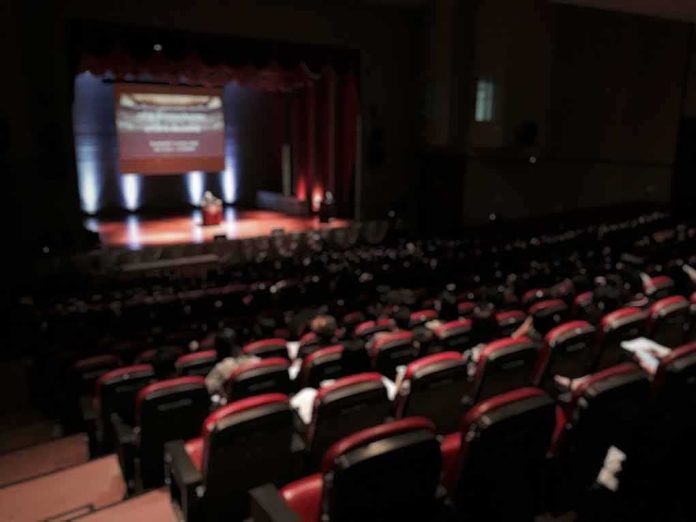
The performance did not occur at a memorial, a rally, or a solemn gathering. It was a Fear& Live tour stop at San Francisco’s Golden Gate Theatre — a hybrid comedy/podcast format where co-hosts banter and the audience participates. The clip circulating shows a karaoke-style rendition of “We Are Charlie Kirk,” with the crowd cheering and the panel laughing, which places the moment within a performative, comedic container rather than a literal tribute. Multiple accounts — including a clip feed that tracks livestreamed shows — describe it as exactly that: a karaoke-style bit, with lyrics on screen and a crowd playing along.
Those mechanics matter. Satire lives or dies on frame: lighting, staging, host tone, audience expectation. A karaoke prompt in a comedy show primes listeners for irony and communal parody; the same lyrics on a church stage or a vigil would communicate something else entirely. The anger that followed online often assumed the latter frame while the actual performance clearly belonged to the former.
From tribute to meme: how “We Are Charlie Kirk” became cultural raw material
To understand the reaction, you have to understand the object. The song began as a sincere, AI-assisted tribute to Charlie Kirk after his killing; it was produced in a devotional register and shared widely. Then it underwent the familiar internet metamorphosis: remixed, parodied, and recontextualized until the earnest origin became part of the joke’s negative space. Even Piker’s own on-stream discussion traced that trajectory — from pious homage to viral meme fodder — which is why invoking it later reads to plugged-in audiences as an act of satire rather than literal reverence.
This pattern is not new. Earnest political media routinely becomes memetic clay, especially when it mixes religiosity, martyrdom language, and simple, anthemic hooks. Once a work enters that churn, its reuse often signals commentary on the cultural handling of tragedy rather than on the tragedy itself. That does not obligate anyone to like the results; it explains the grammar through which online communities read them.
The moral objection: mockery versus satire
The counter-case is straightforward and emotionally compelling: leading a crowd to sing an homage song about a murdered public figure is mockery, full stop. A Turning Point USA spokesman called the act “pure, unadulterated evil,” and coverage across partisan outlets emphasized “mocking” and “trivializing” Kirk’s death, particularly near the anniversary. Through this lens, staging choices and internet in-jokes do not mitigate the basic indecency of turning a killing into content.
Two things can be true at once: the bit operated as satire inside the room, and many viewers outside the room experienced it as desecration. That divergence reflects differing priors about both the performer and the victim, plus the reality that intent cannot be retrofitted onto a clip stripped of its set-up, callbacks, and audience understanding. In other words, reception, not only intent, drives public meaning once a moment goes social.
Hasan Piker’s public record on the killing and political violence
Against accusations of ghoulishness, Piker’s post-killing commentary has consistently condemned political violence and rejected celebratory talk. He described being traumatized by the event, said he regretted losing the chance to debate Kirk, and framed the rush to police tone online as performative rather than principled — a stance that, agree or not, is categorically different from endorsing the murder itself. Those positions do not immunize a later joke from criticism; they do provide relevant context when assessing whether a live-show singalong was meant as celebration of a death or as commentary on the culture that formed around it.
That distinction also maps to the broader First Amendment landscape. Legal scholars routinely note that offensive jokes about public figures — even about attempts on leaders’ lives — are largely protected speech in the United States, unless they cross into true threats or incitement. Taste is a social sanction, not a legal one.
Context collapse: why short clips harden into outrage
What propelled the backlash was not a full set recording but a short, high-affect clip optimized for virality. That is the textbook signature of context collapse: performance-dependent humor is flattened into a content unit decoupled from its framing, then reinterpreted through the audience’s prior loyalties. Researchers and journalists have applied this lens to the Kirk meme ecosystem itself — a wave of “Kirkification” content that took on a life of its own as people projected their politics onto the remixes.
In this environment, platform algorithms reward indignation over nuance; incendiary edits outcompete the longer contextual explainer every time. Once the outrage headline lands — “mocked a murder victim” — subsequent clarifications about setting, staging, or comedic intent reach only the fraction inclined to look for them. The reputational asymmetry is structural, not personal.
How to judge moments like this without being played by the feed
For readers trying to evaluate similar flashpoints, three questions help. First, what was the performance container — comedy show, sermon, vigil, protest — and did the audience in the room experience it as a joke, a tribute, or agitation? In this case, the live-show karaoke container is well attested. Second, what is the cultural status of the referenced object — here, a tribute-turned-meme whose ironic reuse was widespread before this performance. Third, what does the speaker’s broader record show about the underlying harm — Piker’s on-record condemnations of political violence and rejection of celebratory rhetoric weigh against the charge of literal glee at a killing.
None of this absolves tastelessness. It does separate commentary about the spectacle that grows around political martyrdom from celebration of the death itself. A reader can judge the bit harshly on dignity grounds and still recognize how easily short-form circulation can deform meaning, especially where grief and ideology intermingle.
WATCH: Hasan Piker Mocks Charlie Kirk by Singing Tribute Song Made After His Assassination as Audience Cheers. Sad to see Democrats inhumanity https://t.co/lYUaRCJ3zC
— maitri (@clarissamehler) August 23, 2026
The durable lesson: grief, memes, and the limits of irony
This controversy will not be the last. As long as political mourning is staged in public and remixed online, satire and sacrilege will blur, and clips will detonate far from their native context. Performers who work in that space should expect blowback and plan frames that travel — explicit set-up, on-mic disclaimers, post-bit debriefs — because the internet will treat every moment as a standalone artifact. Audiences, for their part, can withhold final judgment until they’ve located the frame. It is not a pass for bad jokes; it is a defense against being conscripted by algorithms into somebody else’s narrative.
Sources:
foxnews.com, youtube.com, x.com, facebook.com, livestreamfails.com, politico.com, instagram.com