The Ground Zero name-reading is not a media moment; it is a carefully structured civic ritual that hands the microphone to families and binds private grief to public memory through silence, names, and time itself.
The Short Version
- Each September 11 in New York, relatives read the names of the nearly 3,000 people killed, anchoring the nation’s remembrance in family testimony rather than political speech.
- The ceremony follows the attack timeline with moments of silence at the precise minutes when planes struck and towers fell; the names are read between those bells.
- The practice is a two-decade tradition: an annual, highly disciplined program that begins in the morning at the National September 11 Memorial plaza and runs for hours.
- Over time, the observance has widened to honor losses from the 1993 World Trade Center bombing and deaths linked to 9/11-related illnesses.
What the annual Ground Zero observance is designed to do
New York’s September 11 observance at the National September 11 Memorial is a family-centered rite with a fixed grammar: a morning start on the plaza, a sequence of bells and silences tied to the day’s original timeline, and the steady cadence of names read aloud by those who lost loved ones. It is a ritual of custody and voice: families carry the memory, read the roll, and—between bells—occasionally add a few personal words about who their mother or brother was and what was taken. Major outlets consistently publish the program in advance, including the plaza location, the early start, and the temporal markers that structure the morning, because the form is stable and intentional, not improvised coverage of a crowd scene.
That stability serves a purpose scholars of memorialization recognize: anchoring collective memory in repetition and restraint so that, year after year, the format itself teaches what is owed and to whom. In New York, that has meant the absence of political speeches, the prominence of relatives as readers, and the organization of the ceremony around silence and names—commemorative choices that move public attention toward witness rather than address.
The mechanics: time, bells, and the reading of names
The program’s spine is the clock. Moments of silence map precisely onto the morning of September 11, 2001: 8:46 a.m. and 9:03 a.m. for the strikes on the North and South Towers; 9:37 a.m. for the Pentagon; 9:59 a.m. for the South Tower’s collapse; 10:03 a.m. for Flight 93 in Pennsylvania; and 10:28 a.m. for the North Tower’s collapse. Bells ring; the plaza falls quiet; then the reading resumes, undertaken by family members who volunteer and, in practice, are selected to share the duty across the community of mourners. The reading covers those killed on 9/11—often reported as 2,977—and, in some program years, explicitly includes the six victims of the 1993 World Trade Center bombing, which is why different outlets may cite 2,983 or use the phrase “nearly 3,000.” All describe the same commemorative intent: completeness, not rounding.
As the years have accumulated, the ceremony has also adapted to encompass related losses that unfolded long after the smoke cleared. Coverage has described additions acknowledging those who died of 9/11-related illnesses, such as cancers and respiratory disease—an expansion that recognizes the disaster’s long tail and the moral obligation to include those whom the day continued to claim years later.
Who speaks and why that matters
At Ground Zero, the readers are not dignitaries. They are spouses, children, siblings, and parents. They step to the microphone, say a name, sometimes add a spare sentence of memory or thanks, and step away. This design choice reallocates authority: leaders attend as witnesses rather than keynotes; families hold the center. It is why accounts of the ceremony emphasize that “traditionally, there are no political speeches” in New York—an unwritten norm enforced by format and expectation rather than flourish and oratory. The effect is unmistakable when compared with other memorial forms: there is no thematic address to interpret the event for the audience. Instead, a litany delivers the meaning—every name, in public, every year.
This family-led structure also explains how the observance carries both intimacy and national scope; the plaza is a place where personal remembrance and public duty coincide. In academic language, the ritual converts individual loss into shared civic memory, using repetition, silence, and the utterance of names to prevent abstraction. In ordinary practice, it means you learn who people were—firefighter, court officer, banker, father—and you hear that they are still loved.
A brief history of a long tradition
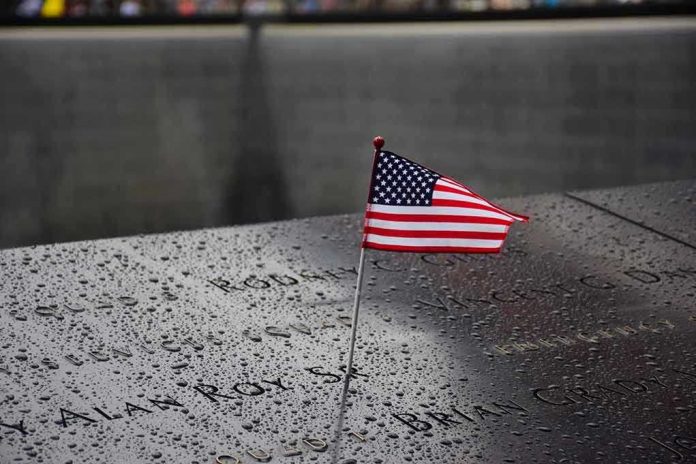
The name-reading began in the first years after the attacks and hardened into custom as the memorial itself took material form. The National September 11 Memorial opened with the names etched in bronze, sorted into “meaningful adjacencies” that reflect relationships—colleagues, first responder units, flights—so that the architecture enshrines connection rather than alphabetical order. The annual ceremony extends that principle into sound: adjacency becomes sequence; the wall of names becomes a morning of voices.
From early anniversaries onward, the New York program retained its core elements. Families read on the plaza. The timing matched the attack chronology. Public officials attended and, in many years, spoke elsewhere. Over two decades, the pattern proved resilient because it met the needs it set out to meet: dignity, accuracy, and the active participation of those most directly bereaved.
Counting the dead and acknowledging the full circle of loss
Readers sometimes encounter inconsistent numbers in coverage—2,977, 2,983, “nearly 3,000.” The discrepancy reflects scope choices, not disagreement about the facts. The standard figure for those killed in the 2001 attacks is 2,977. When the 1993 bombing’s six victims are included within the ritual frame, the total rises to 2,983. The memorial itself refers to “nearly 3,000” names inscribed; the rhetoric gives the public a comprehensible whole while the ritual attends to each person in particular.
In recent years, the program and surrounding coverage have also marked the many thousands who died from 9/11-linked illnesses—harms recognized by federal compensation and health programs and by the community of first responders and survivors who live with their consequences. Some observances have added a distinct bell and silence for these losses, integrating them into the morning without displacing the central name-reading.
🚨 Video footage from the 25th anniversary 9/11 memorial ceremony at Ground Zero appears to show New York City Mayor Zohran Mamdani and Rep. Alexandria Ocasio-Cortez (D-NY) laughing briefly while relatives of victims read the names of those killed in the September 11, 2001… pic.twitter.com/TdDWJaHBy5
— California Courier (@cacourier) September 11, 2026
Why the format endures
The Ground Zero observance persists because it does what durable civic rituals do: it clarifies roles, it keeps faith with fact and family, and it resists the centrifugal pull of politics by giving the ceremony’s voice to those who bear the grief. The morning unfolds as a public act of fidelity to names, times, and bonds—made legible through silence and the simplest speech we have: saying a person’s name aloud.
Sources:
youtube.com, nytimes.com, cbsnews.com, abc7ny.com, apnews.com, cbs8.com, khaleejtimes.com, academic.oup.com, digitallibrary.vassar.edu, digitalcommons.montclair.edu