
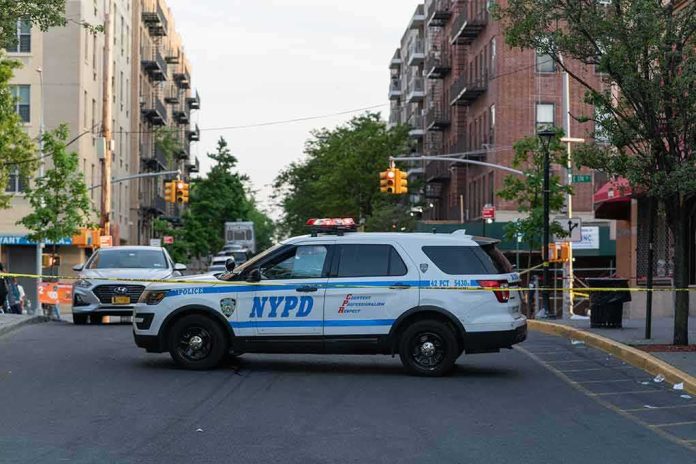
A stray-bullet shooting that wounded a 12-year-old girl in a Bronx playground was not a mystery of urban randomness; police and prosecutors say it was the predictable spillover of a group confrontation that escalated to gunfire—an event with named defendants, a specific scene, and physical evidence to anchor the case.
The Short Version
- Police arrested 26-year-old Destin Burgess and a 13-year-old boy in connection with an October shooting that wounded a 12-year-old girl in a Bronx park; both face attempted-murder and related charges.
- The shooting unfolded around 8:30 p.m. at Pearly Gates Park in Westchester Square; seven shell casings were recovered and nearby cameras captured suspects running from the area.
- The victim was struck in the torso and foot and underwent surgery, consistent with a serious violent-crime prosecution.
- Investigators describe a gang-linked confrontation, including shouted words and hand signs associated with the Mac Ballers set, preceding the gunfire.
What Happened: A Defined Scene, Defendants, and Evidence
According to police announcements and court-linked reporting, the incident occurred in and around Pearly Gates Park on Tratman Avenue in the Westchester Square section of the Bronx, at approximately 8:30 p.m. Investigators recovered seven shell casings and reviewed surveillance footage that appeared to show multiple suspects fleeing after shots were fired. The 12-year-old victim—an uninvolved bystander—was struck in the stomach and in the right foot and required surgery to remove bullets, an injury profile that aligns with felony-level assault and attempted-murder charging decisions.
Within weeks, the NYPD announced the arrest of 26-year-old Destin Burgess, followed by the apprehension of a 13-year-old boy. Reporting indicates both were charged with attempted murder and weapons offenses; neither was specifically accused of being the triggerman in the initial complaint, signaling an accomplice-liability theory that tracks New York’s law of accessorial conduct. Police and local outlets have also emphasized that additional suspects were still being sought, consistent with early descriptions of a group confrontation escalating into gunfire.
The Charging Theory: Accomplice Liability in a Group Gun Case
New York’s Penal Law allows prosecutors to charge those who intentionally aid, solicit, or act in concert with a shooter as principals in attempted murder; the label “accomplice” describes conduct, not a lesser degree of culpability. In practice, prosecutors build these cases through a mosaic of facts: pre-shooting confrontation and signaling, witness descriptions of coordinated actions, video timelines, recovered casings and their ballistic signatures, and flight patterns that connect actors to the moment shots were fired. The reporting here aligns with that template. The complaint, as summarized, does not pin the trigger pull on Burgess or the 13-year-old; rather, it advances a theory that their actions—within a group dynamic immediately before the gunfire—make them criminally liable for the attempted murder that followed.
Physical evidence matters in these prosecutions. Seven shell casings give a forensic foothold: caliber, manufacturer, and any ejector or firing-pin marks can be compared to test fires from recovered weapons; even when a firearm has not yet been seized, casings fix the fact of a shooting and can later link to weapons recovered in follow-on arrests. Layered atop are video segments: approach, confrontation, panic, dispersal. Here, surveillance footage reportedly captured suspects running from the park, a typical thread prosecutors use to stitch together identity and intent with other proofs.
The Confrontation’s Character: Alleged Gang Signaling and Its Legal Relevance
Several outlets attribute to investigators and witnesses a description of shouted words—“Ewok”—and displayed hand signs associated with the Mac Ballers (often stylized “Makk Ballas”), a Bloods-affiliated set, in the moments before shots rang out. In court, such evidence is not an end in itself; it is an indicator of motive, group affiliation, and the foreseeability of violence. Prosecutors tend to use it narrowly: to explain why individuals moved in concert, why an argument metastasized into gunfire, and why non-shooters in a group can still be charged as acting in concert when the risk of lethal violence was not only apparent but invited by the signaling itself.
As a matter of proof, gang ties and identifiers are typically corroborated by a mix of field intelligence, prior contacts, social media artifacts, and expert testimony; in early public reporting, however, they often appear first as shorthand conveyed by police sources. The role of that evidence in this case will be defined by the eventual trial record. For now, the allegation explains why a park dispute at dusk mushroomed into an attempted-murder case rather than a simple assault.
The Victim and the Violence: Why This Case Drew Fast Action
When the victim is a child struck by stray bullets, investigative tempo accelerates. The medical facts as reported here are blunt: wounds to the torso and foot, with at least two bullets surgically removed. That profile squares with New York’s top violent-crime statutes; prosecutors need not prove a fatal intent to charge attempted murder, only that the defendant—or those acting in concert—intended to cause death and took a substantial step toward it. Firing live rounds in a public park, in the direction of a crowd, has long been treated by courts as conduct from which that lethal intent can be inferred.
The community reverberations are also predictable, particularly in the Bronx, where park spaces are a civic commons. A case involving a 12-year-old bystander sends a signal—both to potential witnesses and to those on the periphery of the group involved—that this is not a closed world of combatants. The people who suffer are often far from the dispute’s origin.
Where This Fits in the Citywide Picture
This case sits at the junction of two overlapping trends in New York City. The first is encouraging: shootings have fallen sharply in recent years, with the NYPD reporting 688 shooting incidents citywide in 2025, down roughly a quarter from 2024 and the lowest count on record. The second is harder: within the smaller universe of remaining shootings, youth are a larger share—both as victims and as alleged perpetrators. A city analysis found that, between 2018 and 2024, gun arrests of individuals under 18 rose 136%, identified youth shooting suspects rose 92%, and youth shooting victims rose 81%. Neither trend determines the facts of a particular case, but together they explain why a single Bronx incident can feel both anomalous and emblematic.
Seasonality and place also matter. Gun violence clusters predictably in high-activity corridors and public spaces where peer groups mix, frictions surface, and minor slights—amplified by reputation economies—can escalate. That pattern is precisely why parks and their approaches attract cameras and why shell-casing counts, more than headlines, often tell investigators how many guns were in play and how many decisions to fire were made in that minute of mayhem.
What Comes Next: Evidence, Not Epithets, Will Decide
From here, the case will rise or fall on standard proofs: the surveillance timeline; the shell-casing ballistics; any recovered firearms; eyewitness accounts; and the defendants’ own post-arrest statements, if any. For Burgess, the Bronx Criminal Court docket will crystallize the accessorial theory that early reporting has already sketched; for the 13-year-old, Family Court confidentiality will limit public visibility into filings even as prosecutors pursue parallel investigative steps. The question the law asks is not whether a given defendant held the gun, but whether he intentionally furthered the shooting that put a child in surgery.
In a city where overall gunfire has receded, cases like this become yardsticks for how well institutions handle the hardest residue of the problem. They demand precision: in charging theories that track the evidence; in community engagement that turns witnesses into partners; and in rhetoric that reflects what is known from the record rather than what emotion might supply. The measure of success is simple. Fewer bullets in parks—and when they fly, a case that can stand on its facts.
Sources:
nypost.com, newyork.news12.com, bronx.news12.com, pix11.com, nydailynews.com, ground.news, cbsnews.com, nyc.gov