
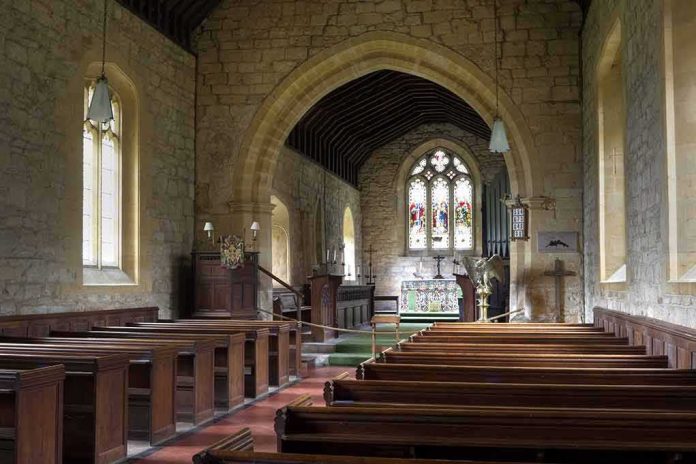
When sacred objects are attacked, the harm is not measured only in monetary loss; it is an assault on living communities, memory, and meaning. That is why a single theft and destruction at a French basilica reverberated far beyond one parish: a man allegedly broke a display case, stole a reliquary containing a bone fragment attributed to Saint Nicholas, and told police he burned and crushed it.
At a Glance
- Police identified a suspect and arrested him at home after the reliquary’s disappearance from the Basilica of Saint-Nicolas-de-Port in Lorraine.
- Reports attribute to the suspect an admission that he smashed the case, took the object, and destroyed the fragment rather than trying to sell it.
- The parish reported the missing reliquary, described as containing a bone fragment of Saint Nicholas, the 4th‑century bishop behind the Santa Claus tradition.
- The stated motive centered on hostility to relic veneration, aligning with destruction rather than resale.
What Happened: A targeted theft and deliberate destruction
Regional reporting and parish accounts describe a straightforward criminal sequence. The Basilica of Saint‑Nicolas‑de‑Port, a well‑known pilgrimage site in northeastern France, discovered that a reliquary was missing from its display. Police were notified by clergy, and investigators subsequently identified and arrested a suspect at his residence. According to those reports, the man acknowledged breaking the protective casing, removing the reliquary, and destroying its contents—a bone fragment associated with Saint Nicholas—by burning and crushing it. Several outlets cite the parish’s own statement summarizing the admission and the sequence of events.
The specificity of place, object, and alleged actions is consistent across accounts: a defined target within a church—an enclosed reliquary—physically breached; an object removed; and, critically, no attempt at monetization. The reported motive tracked with iconoclastic intent rather than profit: disdain for the veneration of relics and a belief that such practices constitute idolatry or fetishism.
Why this case stands out within the broader pattern of religious-object crime
Most theft from places of worship looks depressingly ordinary. Churches and synagogues are often soft targets—open hours, volunteer staffing, predictable display cases—and thieves tend to pursue what can be fenced quickly. Law enforcement and heritage bodies have long warned that religious sites are recurrent targets for theft and damage; quantifying the true frequency is difficult because countries record these crimes unevenly, but the pattern is well recognized. Historic England’s strategic assessments, for instance, highlight how offenders strip valuable metals from church roofs or lift easily moved items that can enter local markets with minimal scrutiny.
This incident diverges on the motive axis. Instead of resale, the reported confession points to deliberate desecration. That matters for both investigation and prevention. Security countermeasures optimized for opportunistic theft—locks, alarms, cameras near silver or copper, marking assets for recovery—do not fully address a perpetrator intent on destroying a devotional object on site or soon after, for whom the object’s symbolic meaning, not its market value, is the draw. The challenge becomes deterring access and hardening displays without undermining a church’s mission of open worship and pilgrimage.
Context: The basilica, Saint Nicholas, and the cultural weight of relics
Saint Nicholas, the 4th‑century bishop of Myra, occupies a rare cultural space: a historical Christian pastor whose legend became the seasonal figure of gift‑giving. The basilica at Saint‑Nicolas‑de‑Port is among the European sites with longstanding devotional links to the saint, who is especially venerated in seafaring and charitable traditions. For believers, relics serve as tangible points of connection to the communion of saints; for historians, they are also artifacts within a centuries‑long exchange of devotion, pilgrimage, and civic identity. The loss or desecration of a relic, therefore, strikes at both religious practice and local heritage.
The reporting identifies the object taken as a reliquary containing a bone fragment attributed to Saint Nicholas; that attribution is the language used by the basilica and by media accounts. The suspect’s alleged statements to investigators—rejecting relic veneration and opting to destroy the fragment—align with a longstanding line of iconoclastic critique in Christian history, though here expressed through criminal means rather than theological argument.
The investigative spine: arrest, admission, and immediate implications
What elevates this beyond rumor or mere disappearance is the arrest anchored to a suspect who, according to multiple reports, admitted to the key acts: forcible entry into the display, removal of the reliquary, and destruction of the fragment. The narrative supplied by parish and regional coverage is coherent on these central points, even as some timelines differ at the margins. Such admissions, when present, typically drive prosecutorial decisions and shape judicial oversight of detention and psychiatric evaluation. Reporting indicates the man was taken into custody following identification by police; one account references a court appearance and evaluation step, routine in cases where motive or mental state may bear on criminal responsibility.
Two practical consequences follow. First, the prospects for physical recovery are slim; destruction forecloses the usual heritage‑recovery pathway. Second, focus shifts to institutional resilience: auditing display security, visitor flow, and alarm coverage; updating parish inventories and documentation; and coordinating with regional heritage protection units—a playbook refined across many jurisdictions precisely because churches sit at the intersection of public access and valuable movable heritage.
How this fits the heritage‑crime landscape
International agencies frame crimes against cultural heritage—whether theft, trafficking, or vandalism—as offenses that wound communities, not just objects. Interpol underscores that places of worship are common targets, alongside private homes and museums, and that stolen items range widely by country and criminal opportunity. The FBI’s guidance to local law enforcement similarly flags religious heritage as a recurring victim class, while acknowledging that uneven reporting and categorization complicate cross‑border statistics. In practical terms, that means prevention and response rely less on global tallies and more on local risk assessment: sightlines to displays, case construction, lighting, timed locks, volunteer training, and the dull but decisive discipline of up‑to‑date inventories.
Where ideological destruction is plausible, deterrence strategies add layers: restricting after‑hours access; quick‑release alarm responses; and thoughtfully balancing visibility with standoff distance so that a would‑be vandal cannot reach an object before a sensor triggers. None of this turns a basilica into a bank vault; rather, it acknowledges that stewardship of devotional art and relics is a professional craft, compatible with hospitality.
MAN ARRESTED FOR SMASHING CASE, STEALING, BURNING & CRUSHING BONES OF ST. NICHOLAS AT BASILICA IN LORRAINE FRANCE
A Suspect Has Been Arrested (BUT NOT NAMED) After Breaking Into A Protective Display Case At The Basilica Of Saint-Nicolas-De-Port In Meurthe-Et-Moselle, France,… pic.twitter.com/lLb8a9tvv7
— John Basham (@JohnBasham) November 9, 2026
What it means for parishes and heritage stewards
Three lessons travel well beyond Lorraine. First, name the risk correctly. If your most vulnerable objects are valued for meaning rather than metal, configure defenses for mission‑targeted harm, not just resale theft. Second, rehearse incident response. Fast, accurate public communication by the parish in this case shaped responsible coverage and gave law enforcement actionable timelines. Third, invest in documentation. Detailed inventories, photography, provenance files, and conservation notes do not stop an attack, but they are the difference between conjecture and a coherent case file—crucial for insurers, prosecutors, and the community’s own historical record.
Sources:
nashaniva.com, dailycaller.com, thecatholicherald.com, dailymail.com